



-
 By:
Valerie Puffenberger, PMHNP-BC
By:
Valerie Puffenberger, PMHNP-BC -
Editor:
Phyllis Rodriguez, PMHNP-BC
-
Clinical Reviewer:
Dr. Ash Bhatt, MD, MRO
 By:
By:
 Editor:
 Clinical Reviewer:
Key Takeaways from Dr. Ash Bhatt
- If you’re taking a higher dose than your prescription allows without calling your doctor first, that’s not tolerance anymore, that’s dependency forming in real time.
- Could you skip tomorrow’s dose without dread creeping in beforehand? If the honest answer is no, you’re already past the early warning stage.
- The sign I never let a patient brush off is withdrawal between scheduled doses. Feeling sick right before your next pill isn’t “sensitivity,” it’s your body confirming physical dependence has taken hold.
Millions of people take prescription medication every day exactly as their doctor intended, yet somewhere along the way, the relationship between the person and the pill shifts quietly. This is concerning and makes identifying the signs of prescription drug dependency early important so that treatment can begin as soon as possible without going through the hardships of regret later.
In this article, we’ll walk through the 10 signs of prescription drug dependency people often ignore, why they get overlooked, and what to do if you or someone you love is experiencing them.
What Is Prescription Drug Dependency?
Dependence and addiction are related, but they aren’t the same thing. Dependence happens when your body adapts to a medication and starts to rely on it to function normally, sometimes even when you’re taking it exactly as prescribed. Addiction, on the other hand, involves compulsive use of a drug despite the harm it’s causing to your health, relationships, or daily life.
This distinction matters because it changes how dependency shows up. Someone can develop prescription drug dependence symptoms without ever misusing their medication on purpose, simply because their body has adjusted to consistent exposure. If left unaddressed, that physical dependence can progress toward the compulsive patterns.
Learn More About Prescription Drug Addiction here
That’s exactly why catching these signs of prescription drug addiction early matters. The earlier dependency is identified, the more treatment options are available and the less disruptive the transition back to independent, medication-free functioning tends to be.
Why Prescription Drug Dependency Is Often Missed
Prescription drug misuse signs slip past even attentive families and patients for a handful of predictable reasons. Let us understand why this issue is so widespread.
- The medication is legally prescribed, which creates a false sense of safety around any amount taken.
- Symptoms develop gradually, often over months, making them easy to attribute to something else.
- Family members assume the medication is inherently safe simply because a doctor prescribed it.
- Many people normalize increasing their own dose, viewing it as simply “needing more” rather than a warning sign.
- Symptoms resemble stress, aging, or an existing mental health condition, which makes dependency easy to mistake for something unrelated.
10 Signs of Prescription Drug Dependency People Often Ignore
None of the signs below exists in isolation. Most people experiencing prescription drug dependence symptoms will recognize two, three, or more of these at once, even if each one felt explainable on its own at the time. The goal here is to notice the pattern.
1. You Need Higher Doses to Get the Same Effect
Tolerance is one of the earliest and most common prescription drug dependence symptoms. Over time, your body becomes less responsive to the same dose, so the medication that once worked well starts to feel less effective.
This often leads people to escalate their own dosage without consulting their doctor, whether that means taking an extra pill or shortening the time between doses. For example, someone prescribed a painkiller after surgery might notice that six months later, their original dose barely takes the edge off.
That escalating need, without medical guidance, is one of the clearest warning signs of prescription drug abuse. Self-adjusting a dose might feel like problem-solving in the moment, but it’s usually the body asking for medical reassessment.
2. You Feel Sick or Anxious When You Miss a Dose
Early withdrawal symptoms are often mistaken for the flu, anxiety, or simply having a bad day. Irritability, sweating, restlessness, and headaches that show up specifically when a dose is missed or delayed point to something more physiological than a rough morning.
What makes this sign tricky is timing. If the discomfort consistently lines up with a delayed dose and eases shortly after taking it, that pattern is worth paying attention to rather than explaining away as coincidence.
This is different from simply not feeling well in general. It’s a specific, repeatable cycle tied to the medication schedule, and that repetition is what separates ordinary stress from an early physical dependence forming underneath it.
Understanding Drug Withdrawal can help clarify where that line sits.
From Dr. Ash Bhatt’s Perspective:
In my practice, I’ve had patients tell me they thought they were just “stressed” until we mapped their symptoms against their dosing schedule. Once we lined it up, the connection to physical dependence became impossible to ignore.
3. You Constantly Think About Your Medication
When medication starts occupying more mental space than it should, that’s worth paying attention to. This can look like planning your entire day around refill dates, counting and recounting pills, or feeling a spike of anxiety at the thought of running out.
These obsessive thoughts don’t necessarily mean someone is misusing their medication intentionally. Often, they reflect the body’s growing reliance on the drug to feel stable, which is one of the quieter signs of prescription drug dependency that rarely gets discussed openly.
4. You Visit Multiple Doctors or Pharmacies
Sometimes called “doctor shopping,” this pattern involves requesting prescriptions from more than one provider or filling them at different pharmacies to avoid detection. It can also show up as frequent claims of lost prescriptions or repeated early refill requests.
- Seeing more than one doctor for the same or similar medication
- Switching pharmacies to avoid raising questions
- Reporting lost or stolen prescriptions more than once
- Requesting refills earlier than the prescribed schedule allows
This behavior is one of the more visible warning signs of prescription drug abuse, and it typically signals that dependence has progressed further than the person may be willing to admit.
5. Everyday Responsibilities Begin to Slip
As dependency develops, medication use starts competing with daily obligations. Work performance may decline, appointments get missed, and concentration becomes noticeably harder to maintain.
A person who was once reliable at work might start showing up late, missing deadlines, or losing focus during meetings without any obvious external cause. When these changes coincide with medication use, they deserve a closer look rather than being brushed off as a rough patch.
6. Friends or Family Notice Personality Changes
Loved ones are often the first to notice shifts that the person experiencing them can’t see in themselves. Mood swings, sudden irritability, withdrawal from social activities, and unexplained secrecy are common prescription medication dependence symptoms observed by those closest to the situation.
Defensiveness about medication use, especially when questions are asked out of genuine concern, is another pattern worth watching. If family members are independently raising similar concerns, that consistency matters more than any single observation.
7. You Mix Prescription Drugs With Alcohol or Other Medications
If you are combining prescription medication with alcohol or other drugs, no matter if it was prescribed or not, it definitely raises the risk of dangerous interactions. This can lead to excessive sedation, slowed breathing, and a heightened risk of overdose.
As per the researches done, prescription drug misuse costs the United States an estimated $78.5 billion annually, and dangerous drug combinations are a significant contributor to that toll. You might think drinking a glass of wine with a routine prescription is normal but it can interact in ways that you would never expect. With that said, while you are taking prescription medicines and you have Alcohol Addiction too, the medical risk increases significantly.
What Dr. Ash Bhatt’s Has to Say:
I want to be direct about this one: mixing substances is one of the most preventable causes of medical emergencies I encounter. Patients rarely set out to combine substances dangerously, it usually happens gradually, and that’s what makes it worth flagging early.
8. You Continue Taking the Medication Even After the Original Problem Improves
Medications are prescribed to treat a specific issue, whether that’s pain, anxiety, or ADHD. When the original condition improves but the medication use continues at the same level, it’s a sign the relationship with the drug has changed.
This is especially common with pain management, where physical injuries heal long before medication habits do. Continuing to take a prescription without a current medical reason is one of the clearer signs of prescription drug addiction that people talk themselves out of questioning.
9. You Experience Withdrawal Symptoms Between Doses
This differs from missing a dose entirely; it’s a pattern of feeling unwell even on a normal dosing schedule, right before the next dose is due. Symptoms can include tremors, sweating, insomnia, nausea, cravings, or panic.
- Physical tremors or shakiness before the next scheduled dose
- Sweating or chills unrelated to temperature or illness
- Difficulty sleeping that lines up with the medication schedule
- Cravings or preoccupation with taking the next dose early
According to the National Institute on Drug Abuse (NIDA) roughly 5.1% of Americans, or about 14.3 million people, reported misusing a prescription psychotherapeutic drug in the past year. When withdrawal symptoms appear between scheduled doses, it usually means the body’s dependence has advanced past the early stages.
10. You Feel Unable to Stop Without Help
This is often the sign people are most reluctant to admit, even to themselves. It can show up as a genuine fear of withdrawal symptoms, one or more failed attempts to cut back, or a sense that daily functioning simply isn’t possible without the medication.
Both emotional and physical dependence can make stopping feel impossible without support, and that’s a reasonable thing to feel. It’s also exactly the point where Prescription Drug Detox and structured treatment become the safer path forward, rather than attempting to stop alone.
Clinical Perspective of Dr. Ash Bhatt:
This is the sign I take most seriously in a first conversation. A patient telling me they’ve tried to stop and couldn’t stop is clearly a clinical data point that tells me exactly how much support their body actually needs.
Who Is Most at Risk of Developing Prescription Drug Dependency?
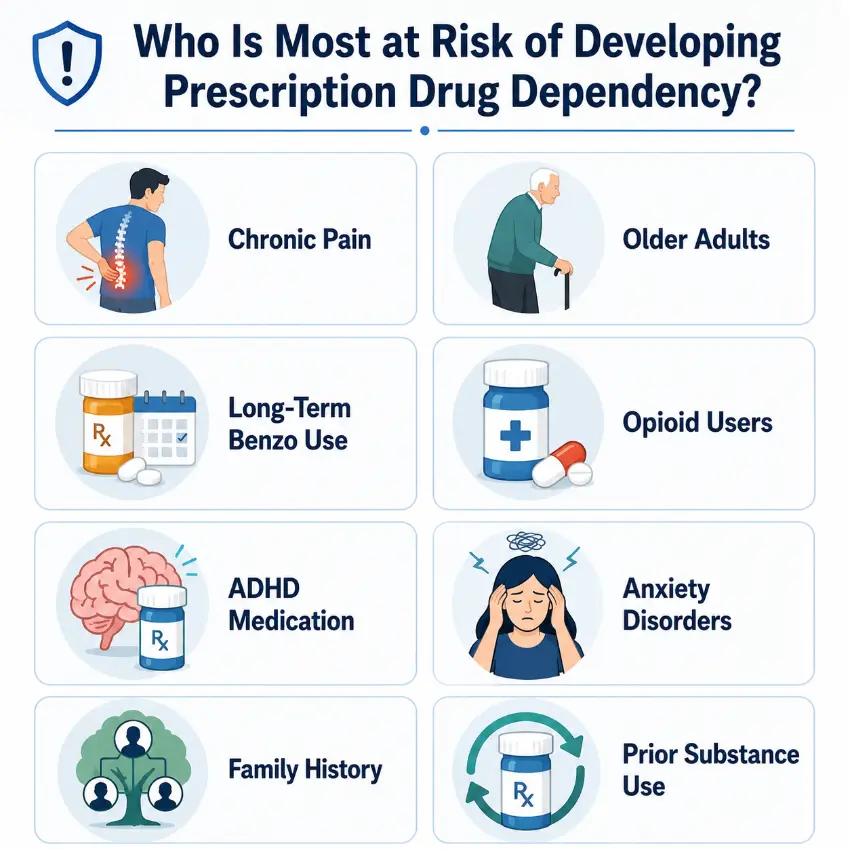
Dependency risk is distributed very unevenly. Certain groups face a meaningfully higher chance of developing prescription medication dependence, largely because of how their medications are used, for how long, and alongside what else.
- Chronic pain patients often stay on opioid medications for extended periods, giving the body more time to build tolerance.
- Older adults frequently manage several prescriptions at once, which raises both interaction risk and the chance of unnoticed dependence.
- Long-term benzodiazepine users, including those on Xanax Addiction-related medications for anxiety, face a well-documented risk of physical dependence with extended use.
- Opioid users, particularly those prescribed medications tied to Oxycodone Addiction, are among the highest-risk groups for both tolerance and withdrawal.
- ADHD medication users managing stimulant prescriptions, including those connected to Adderall Addiction, can develop dependence even at therapeutic doses.
- Individuals with anxiety disorders may come to rely on medication as their primary coping mechanism, which increases dependency risk over time.
- People with a family history of addiction carry a genetic predisposition that can make dependence develop faster.
- Individuals with a previous substance use disorder have a documented, elevated risk of dependency recurring through a new medication.
Adults aged 65 and older deserve particular attention here, given that 88.6% of patients in this age group use at least one prescription medication daily, often alongside several others.
To understand how prescription dependence develops in the first place, check out our blog here
When Should You Seek Professional Help?
There’s no single moment that marks the “right time” to seek help, but a few situations should move that decision up your priority list. If you’re noticing more than one sign from this article at the same time, that overlap alone is meaningful, since dependency rarely presents as a single isolated symptom.
Certain scenarios warrant reaching out to a medical professional without waiting to see if things improve on their own:
- You’ve increased your own dosage more than once without your doctor’s involvement
- Withdrawal symptoms are showing up on a regular schedule, not just occasionally
- You’ve tried to stop or cut back, but weren’t able to
- Prescription medication is being combined with alcohol or other drugs
- You’ve had a close call or a genuine concern around overdose
The medical reality is that stopping certain medications abruptly, particularly opioids or benzodiazepines, carries real risk and should never be attempted without supervision. Reaching out earlier rather than later isn’t an overreaction; it’s what gives a doctor the most options to work with.
How Legacy Healing Can Help
We at Legacy Healing Center have a structured path forward for individuals experiencing prescription drug dependency, built around medical safety and long-term stability.
Our approach includes Medical Detox to manage withdrawal safely, inpatient treatment for focused recovery, individual and group therapy, dual diagnosis care for co-occurring mental health conditions, and aftercare planning to support lasting change.
Whether dependency involves opioids, benzodiazepines, stimulants, or another prescription class, treatment is tailored to the specific medication and the person’s individual history. If opioids are involved, our Opioid Addiction and Fentanyl Addiction programs are designed specifically for that level of medical complexity.
Conclusion
Prescription drug dependency usually does not come to light overnight. Rather, it is built over time through little changes which are quite difficult to spot unless you actually take notice. You might not see them coming, In particular if the medicine involved has been prescribed lawfully by a medical practitioner. Recognizing prescription drug dependence symptoms early, whether it’s rising tolerance, withdrawal between doses, or shifts a family member notices before you do, gives you far more options for addressing it safely.
If any of these signs sound familiar, that recognition itself is a meaningful first step. Reaching out for professional support early can prevent dependence from progressing into a more complex, harder-to-treat addiction.