



-
 By:
Valerie Puffenberger, PMHNP-BC
By:
Valerie Puffenberger, PMHNP-BC -
Editor:
Phyllis Rodriguez, PMHNP-BC
-
Clinical Reviewer:
Dr. Ash Bhatt, MD, MRO
 By:
By:
 Editor:
 Clinical Reviewer:
Methamphetamine clears from the bloodstream faster than most people expect; even so, this does not imply that the drug is totally eliminated from your body or brain. In fact, the answer mainly varies based on the target of testing, method of testing, and individual being tested.
This article breaks down detection windows across every major test type, biological changes around these timelines, and the reason why having the drug out of your system is just one phase of a very extended recovery process.
Key Takeaways
- The half-life of meth is about 10-12 hours, though I have also seen cases where individuals had a positive result days later on the urine test. The drug leaving your blood doesn’t mean your nervous system has recovered, not by a long shot.
- When patients ask me how long meth stays detectable, I tell them the test type matters enormously. A hair follicle screen looks back 90 days; a blood test closes its window in under 48 hours. Know which test you’re dealing with.
- What concerns me clinically isn’t just detection time, it’s the dopamine depletion that follows meth use. That neurological impact lingers well past any negative drug test, and it’s where real treatment work begins.
Meth Detection Times at a Glance
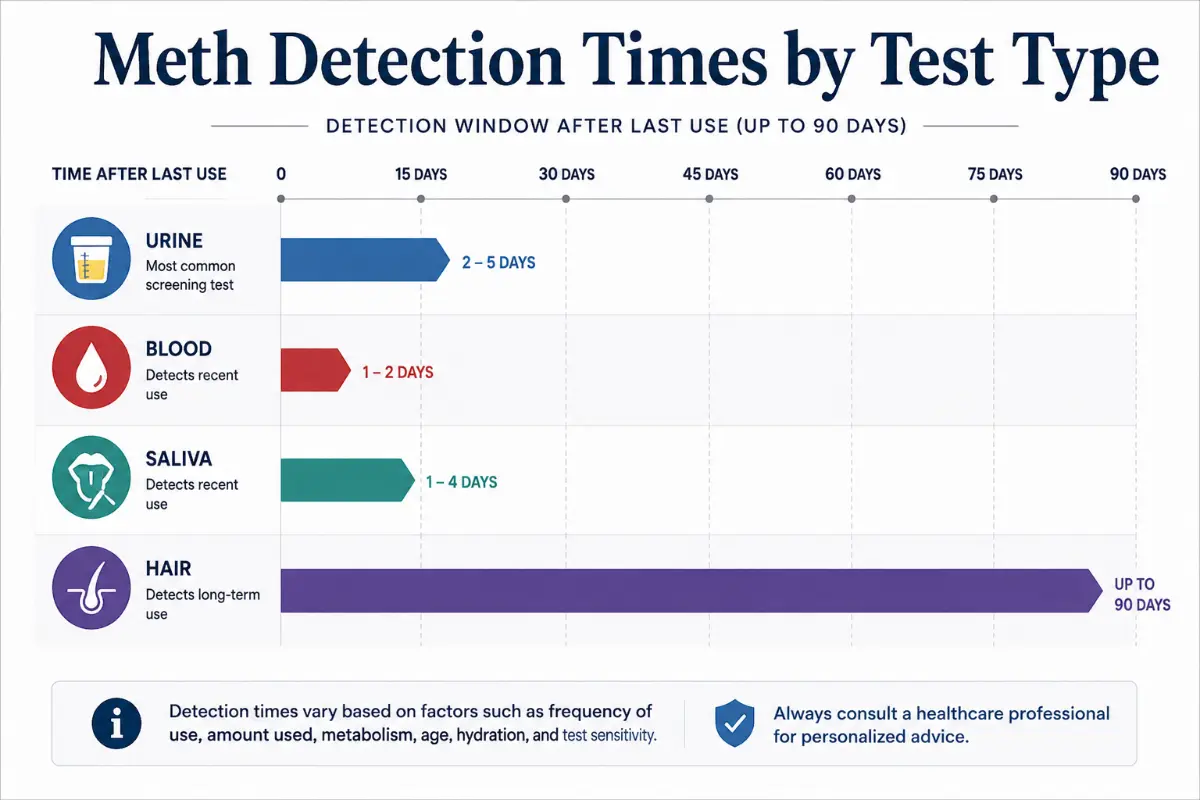
Before getting into the specifics of each test, here’s a quick reference for how long methamphetamine is typically detectable:
| Test Type | Detection Window |
| Urine | 1–5 days (up to 7 days with heavy use) |
| Blood | Up to 48 hours |
| Saliva | 1–2 days (up to 4 days in some cases) |
| Hair | Up to 90 days |
These are general ranges, not guarantees. Individual biology, frequency of use, and testing sensitivity all affect the actual outcome.
How Long Does Meth Stay in Urine?
The average timeframe that urine testing can detect meth is about 72 hours after the last time it was taken. Yet, it should be mentioned that the detection time really depends on the type of drug and its intoxicating elements. For instance, amphetamine-type stimulants are present in the urine for around 3 to 5 days after last use.
Urine analysis is the test which is most commonly used by employers, rehab centers, as well as the judiciary since it is minimally invasive, affordable, and brings a longer detection period than blood or saliva. Another interesting point is that meth converts into amphetamine after being metabolized, so in fact, a drug test might show the presence of both substances.
How Long Does Meth Stay in Blood?
Blood tests provide the most precise indication of what is present in a person’s body, still, the detection period is very short. Usually meth can be detected in blood for 1-3 days after the last intake. Due to its invasive nature and the necessity of a trained professional to administer it, blood testing is mainly used in medical facilities, emergencies, and forensic cases, and not in regular workplace drug screenings. It is particularly valuable as it shows the current level of impairment rather than the past usage.
How Long Does Meth Stay in Saliva?
Saliva testing can detect meth almost immediately after ingestion, sometimes within 5 to 10 minutes, with a detection window of 1 to 2 days. Some sources put the upper range at 4 days, depending on frequency of use and individual metabolism.
Saliva testing is starting to be one of the preferred methods for roadside checks and corporate drug-testing. The biggest reason is that it’s quite challenging to adulterate the sample, and it basically gives a picture of your recent drug use instantly. In other words, if you consumed drugs five days back, it probably won’t detect, but if you did that morning, it definitely will.
How Long Does Meth Stay in Hair?
Hair follicle testing is in a different category entirely. Meth use can be detected via a 1. 5-inch hair sample going back as far as 90 days. That’s why it’s the go-to method in cases where one’s drug use record over an extended period is still relevant, such as in child custody hearings, security clearances, and criminal investigations.
The mechanism works differently than other test types. The metabolites of methamphetamine are carried by the blood and get embedded in the hair shaft during its growth. The hair essentially creates a timeline. One limitation is that it cannot catch very recent drug use as it usually takes about a week up to ten days for drug metabolites to be present in freshly grown hair.
What Factors Affect How Long Meth Stays in Your System?
Detection windows are averages, not certainties. Several individual variables shift those timelines significantly:
Frequency and amount of use. Someone who used meth once will clear it faster than someone who has been using daily for months. Chronic, heavy use saturates body tissue, which extends detection time across all test types.
Metabolism rate. Younger individuals and those with faster metabolisms typically process and eliminate meth more quickly. Age, thyroid function, and liver health all play a role.
Body composition. Meth and its metabolites can accumulate in fatty tissue. People with higher body fat percentages may retain detectable levels longer than someone with lower body fat.
Hydration and urine pH. More acidic urine eliminates meth faster. This is one reason some people attempt to manipulate test results through hydration, though labs are aware of and test for dilution.
Method of administration. Smoking or injecting meth produces a more intense and rapid effect, and may also affect how efficiently it’s metabolized compared to oral or nasal use.
Kidney and liver function. About 30–50% of meth is excreted unchanged through the kidneys, with the rest metabolized by the liver. Any impairment to either organ slows elimination. Right Choice Recovery
Understanding Meth’s Half-Life
The half-life of a drug is the time it takes for the body to reduce the concentration by half. Meth has a half-life of approximately 10 to 12 hours, meaning it takes roughly that long for half of the drug to be eliminated from the body. Guardian Recovery
That sounds relatively short, but it compounds. After one half-life, half remains. After two, a quarter remains. After four or five half-lives, the drug is considered cleared from plasma. That puts full blood clearance somewhere around 48 to 60 hours for most people, which aligns with blood and saliva detection windows. Urine, which concentrates metabolites, holds detectable levels longer.
What Dr. Ash Bhatt Has to Say:
“The half-life number is the one patients fixate on, and I understand why, it sounds reassuring. But I always explain that half-life describes plasma clearance, not neurological recovery. A urine screen can come back negative while the brain is still operating in a significantly depleted dopamine state. Clearing the drug and recovering from it are two separate processes, and confusing them is one of the ways people walk into relapse, believing they’re ready when they’re not.”
Can You Get Meth Out of Your System Faster?
There’s no clinically validated method to meaningfully accelerate meth elimination. The body processes it at the rate its physiology allows.
That said, a few things support the body’s natural elimination process:
- Staying well-hydrated supports kidney function and normal urine output
- Rest and adequate sleep allow the body to focus resources on metabolic processing
- Eating balanced meals supports liver function, which handles a significant portion of meth metabolism
- Avoiding other substances removes an additional metabolic burden from the liver
What doesn’t work: detox drinks, excessive water loading, niacin, exercise in the hours before a test, or any supplement claiming to “flush” your system. These approaches are not supported by clinical evidence, and some carry their own health risks.
Meth Withdrawal Timeline
When someone who has been using meth regularly stops, the body’s adjustment process follows a relatively predictable arc, though severity varies widely based on how long and heavily someone has used.
Hours 0–24: The crash begins almost immediately. Fatigue is intense, often described as a total collapse of energy. Hunger increases sharply after the appetite-suppressing effects of meth wear off. Mood drops significantly.
Days 1–3: This is typically the most acute phase. Deep depression, hypersomnia, strong cravings, and dysphoria are common. Some people sleep for extended stretches during this period.
Days 4–14: The acute physical phase begins to lift, but psychological symptoms become more prominent. Anxiety, irritability, difficulty concentrating, and flat affect (anhedonia, the inability to feel pleasure) are the hallmarks of this stage. Cravings remain high.
Weeks 2–4 and beyond: Chronic meth use can reduce dopamine transporter levels by up to 20%, even after extended periods of abstinence. This protracted withdrawal phase, sometimes lasting weeks to months, is where the real risk of relapse lives, because the brain is still recalibrating its reward system. ISSUP
Meth Can Leave Your System Before Your Brain Fully Recovers
This is the part that doesn’t make it into most detection timelines, and it matters more than any of the numbers above.
A negative drug test does not equal neurological recovery. Protracted abstinence syndrome in stimulant use disorder can extend 12 to 24 months beyond acute withdrawal. During this period, individuals may experience persistent cognitive slowing, low motivation, anhedonia, and vulnerability to cravings that feel entirely disproportionate to the circumstances.
This isn’t weakness or a lack of willpower. It’s the brain’s dopamine system, depleted and restructured by meth use, working to rebuild itself. That process takes time, clinical support, and the right structure around it.
Clinical Perspective from Dr. Ash Bhatt:
“I’ve had patients show me a negative urine test and ask if they’re ‘clean’ now. Medically, yes, the drug has cleared. But the brain doesn’t reset on the same schedule as a test strip. The anhedonia, the flat mood, the sleep disruption, those are still signs of an active recovery process. Treating those symptoms seriously, rather than assuming they’ll resolve on their own, is what actually gets people to stable ground.”
When Is It Time to Seek Professional Help?
Knowing meth’s detection window is useful information, but it’s worth asking a more direct question: is the substance use itself something that needs professional support?
Some clear signals that the answer is yes:
- Use has become more frequent or the amount needed to feel the same effects has increased
- Stopping or cutting back has resulted in withdrawal symptoms, even mild ones
- Meth use is affecting work, relationships, finances, or physical health
- There have been attempts to stop that haven’t stuck
- Anxiety, depression, or sleep disruption have become part of daily life even between uses
These aren’t character flaws. They’re signs of a substance use disorder that responds well to structured, evidence-based treatment.
Meth Detox and Treatment Options
Meth detox is the process of managing the initial withdrawal symptoms in the presence of a healthcare professional. As meth withdrawal causes a very complex set of psychological symptoms, very strong cravings, and even the possibility of long-term effect on the brain, expert help at least for the first one or two weeks, greatly reduces the possibility of relapse and at the same time, the difficulties of the crash period are effectively managed.
In our center, a medically supervised detox is just the starting point, not the whole story. What comes next – individual counseling, group therapy, dual diagnosis treatment for depression or anxiety, and an organized aftercare – is what really makes detox worthwhile.
If substance use is occurring at the same time as a mental health problem, and if the mental health problem has not been properly treated, then the two issues need to be worked on together. This is one of the biggest reasons people keep going back to using when they are only treating one and ignoring the other.