




-
 By:
Valerie Puffenberger, PMHNP-BC
By:
Valerie Puffenberger, PMHNP-BC -
Editor:
Phyllis Rodriguez, PMHNP-BC
-
Clinical Reviewer:
Dr. Ash Bhatt, MD, MRO
 By:
By:
 Editor:
 Clinical Reviewer:
Yes, it is possible to overdose on Prozac (fluoxetine), and while most cases are not fatal when treated promptly, the line between uncomfortable and dangerous can shift quickly depending on what else is in the picture. That’s exactly why understanding the warning signs matters before an emergency, not during one.
According to the American Association of Poison Control Centers, antidepressants consistently rank among the top drug categories involved in poisoning cases reported to U.S. poison control centers each year. Fluoxetine, as one of the most widely prescribed SSRIs in the country, naturally accounts for a meaningful share of those cases.
This article covers what a Prozac overdose actually looks like, why some people face greater risks than others, what emergency care involves, and when a medication-related incident may signal the need for broader mental health support.
Key Takeaways
|
Understanding the Risks of Taking Too Much Prozac
Not every Prozac overdose involves intentional misuse, and that’s an important distinction to make early. Many cases begin with something far more ordinary.
Accidental double doses are among the most common scenarios. Someone takes their morning medication, gets distracted, and genuinely cannot remember whether they took it. They take it again. With fluoxetine, especially at higher prescribed doses or when combined with other substances, the consequences can be more significant than people anticipate.
Medication errors are another overlooked cause. Prescriptions change, dosages get adjusted, and anyone managing multiple medications can lose track of what they’ve taken and when. According to the FDA, medication errors affect millions of Americans annually, with dosage mistakes representing one of the most common categories reported.
Taking more than prescribed also happens outside the context of addiction. Someone experiencing a severe depressive episode may believe that more medication will work faster. That reasoning is understandable but clinically inaccurate, fluoxetine does not work that way. Exceeding the prescribed dose does not accelerate its therapeutic effect; it only increases risk.
Intentional misuse deserves to be named without judgment. When someone takes Prozac in excess deliberately, it usually signals a mental health crisis that extends well beyond the medication itself, and that moment of crisis is often an entry point into more comprehensive support, including our dual diagnosis treatment program.
Warning Signs That Require Immediate Attention
Knowing what a Prozac overdose looks like in real time is the most practical form of preparation, both for the person taking the medication and for anyone close to them.
Mild to moderate symptoms may include:
- Nausea, vomiting, or diarrhea
- Drowsiness or unusual fatigue
- Tremors or shakiness
- Rapid or irregular heartbeat
- Dizziness or loss of coordination
More serious symptoms that indicate escalation:
- Severe agitation or confusion
- Muscle rigidity or uncontrollable twitching
- Seizures
- High fever
- Loss of consciousness
If the person is unresponsive, having a seizure, cannot breathe normally, or is showing signs of serotonin syndrome, call 911 immediately. Do not wait to see if symptoms improve on their own, time is the most critical variable in any overdose situation.
When Prozac Becomes Dangerous: Understanding Serotonin Syndrome
Most discussions of Prozac overdose mention serotonin syndrome briefly and move on. It deserves more space, because it is the mechanism through which a fluoxetine overdose becomes genuinely life-threatening.
Serotonin syndrome occurs when there is excessive serotonergic activity in the nervous system. Fluoxetine works by blocking the reabsorption of serotonin in the brain, keeping it active longer. When taken in excess, or combined with other substances that also raise serotonin levels, the system becomes overwhelmed.
Common causes include:
- Taking more fluoxetine than prescribed
- Combining fluoxetine with other antidepressants (especially MAOIs or SNRIs)
- Mixing fluoxetine with certain migraine medications (triptans), pain medications, or supplements like St. John’s Wort
Early warning signs of serotonin syndrome:
- Restlessness, agitation, or anxiety that appears suddenly
- Rapid heart rate and elevated blood pressure
- Dilated pupils
- Muscle twitching or jerking (myoclonus)
- Heavy sweating or goosebumps
According to the National Institutes of Health, serotonin syndrome can progress from mild symptoms to life-threatening complications within hours. Left untreated, it can lead to hyperthermia, severe muscle breakdown, seizures, and cardiac arrhythmias.
Clinical Perspective from Dr. Ash Bhatt“Serotonin syndrome is the scenario where I most want patients and families to act without hesitation. The early signs, the agitation, the twitching, the racing heart, are easy to write off as anxiety or a bad reaction to medication. But when those symptoms appear in someone who has taken more fluoxetine than prescribed or combined it with another serotonergic substance, that is not a side effect. That is a medical emergency that belongs in an ER, not under observation at home.” |
Why Some People Face Greater Risks Than Others
A Prozac overdose does not affect every person the same way, and understanding why helps explain why one person might experience mild discomfort while another faces a serious medical crisis from a similar dose.
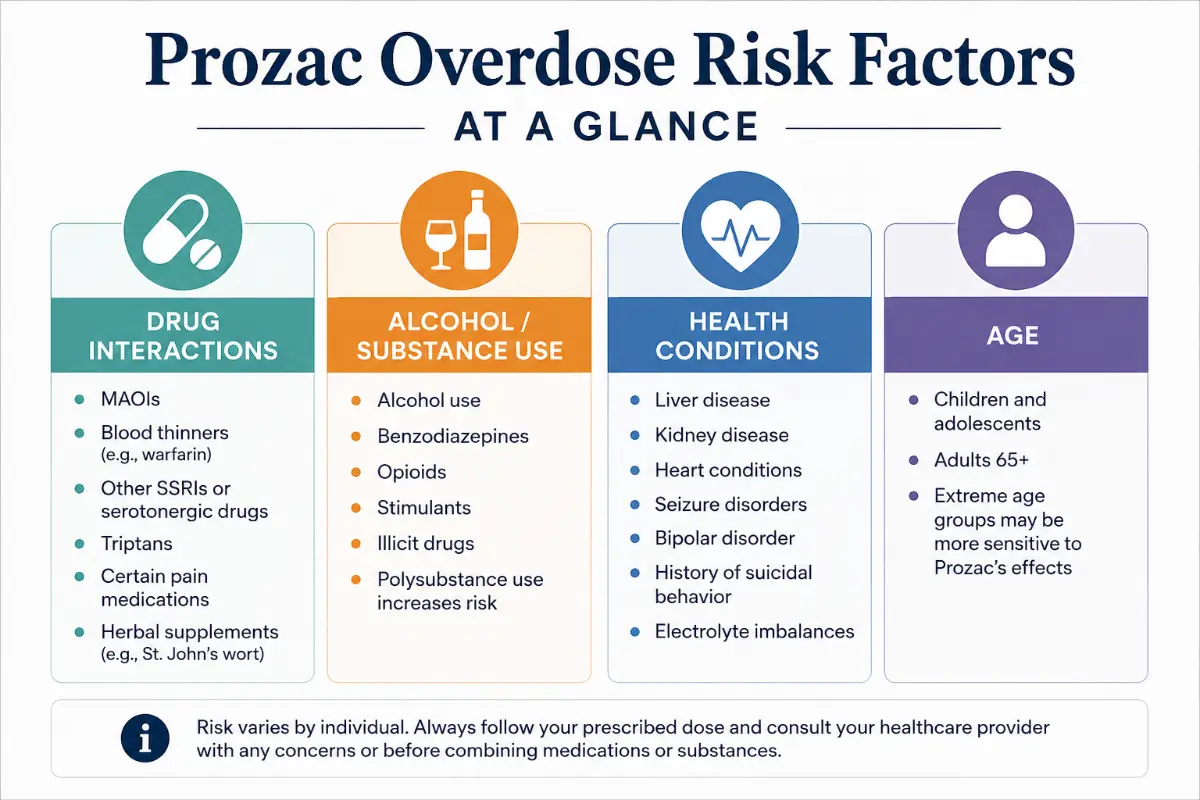
- Medication interactions are a primary factor. Fluoxetine is known to inhibit certain liver enzymes (particularly CYP2D6), which affects how the body processes dozens of other drugs. This means that someone taking fluoxetine alongside other antidepressants, certain antihistamines, antipsychotics, or pain medications may have higher-than-expected levels of one or more substances in their system.
- Alcohol and recreational drug use compound the risk significantly. Alcohol destabilizes mood, impairs judgment, and interacts unpredictably with fluoxetine. MDMA carries a particularly high risk of serotonin syndrome when combined with SSRIs. The Substance Abuse and Mental Health Services Administration (SAMHSA) consistently reports that a significant proportion of psychiatric emergency visits involve combinations of prescription medications and other substances rather than a single drug used in isolation.
- Existing health conditions also shape how severely an overdose manifests. People with cardiac conditions, seizure disorders, liver disease, or kidney dysfunction metabolize fluoxetine differently, and their threshold for a dangerous reaction may be lower than in otherwise healthy individuals. For those managing co-occurring conditions, our medical detox program offers supervised stabilization designed with that complexity in mind.
- Age and overall health matter too. Older adults metabolize medications more slowly. Younger individuals, particularly adolescents, may be on lower doses but are also more likely to have fluctuating mental health symptoms that increase overdose risk.
What Happens After a Prozac Overdose?
This is the section most articles stop short of covering, yet it’s often what people most need to understand before they’re willing to seek help.
When someone arrives at an emergency room with a suspected Prozac overdose, the first step is evaluation. Medical staff will assess vital signs, document what was taken and approximately when, and run blood work to understand what’s circulating and at what levels. A detailed medication and substance history is collected as quickly as possible.
- Monitoring and stabilization depend on what’s found. Mild overdose cases are often managed with supportive care, IV fluids, and cardiac monitoring over several hours. Serotonin syndrome cases require more intensive intervention, including medications such as cyproheptadine to reduce serotonin activity, along with management of the fever, muscle symptoms, and cardiovascular effects driving the crisis.
- Recovery and follow-up care are where the clinical picture broadens. Once a patient is medically stable, the responsible next step is not simply discharge with instructions to be more careful. A psychiatric evaluation, medication review, and coordinated follow-up care are standard practice in a thorough treatment protocol. If that evaluation surfaces concerns about depression severity or co-occurring substance use, connecting with our outpatient mental health program or dual diagnosis treatment can bridge that gap before a second crisis occurs.
The Hidden Risks Beyond the Medical Emergency
A Prozac overdose, whether accidental or intentional, sometimes surfaces concerns that had been building for a while.
- Worsening mental health symptoms are not uncommon around a medication incident. Depression, anxiety, and mood instability can intensify when medication routines are disrupted, or when an underlying condition isn’t being adequately treated by the current plan.
- Medication mismanagement is rarely the whole story when it becomes a recurring pattern. When someone consistently misses doses, adjusts their own dosage, or takes more than prescribed, it often reflects a treatment plan that isn’t working well enough for where that person currently is.
- Self-medicating with alcohol or drugs alongside prescription medications is a pattern that mental health professionals encounter regularly. It frequently goes undisclosed to the prescribing physician, which significantly changes the safety profile of any medication. According to NIDA, roughly half of people with a substance use disorder also have a co-occurring mental health condition, and that overlap is especially common among people managing depression with antidepressant medications.
- Family members are often the first to notice changes in behavior, medication use, or mood stability. If someone close to you is showing signs of distress around their medication or mental health treatment, that concern is worth raising directly rather than waiting for it to resolve on its own.
Clinical Perspective from Dr. Ash Bhatt“When I see a patient who has had a medication-related emergency, I don’t treat it as a closed case once they’re physically stable. I treat it as an opening. What were they struggling with that we weren’t fully addressing? Was there something happening at home, at work, or internally that made this the moment things escalated? Those conversations are often the most valuable ones we have, and they only happen if someone asks.” |
When Is It Time to Seek Additional Support?
Some situations call for more than a medication adjustment.
- Repeated medication-related incidents, even ones that seem minor, suggest that the current treatment structure isn’t providing enough support.
- Ongoing depression or anxiety that hasn’t improved despite medication may indicate the need for a different treatment approach, therapy, a medication review, or a more comprehensive psychiatric evaluation.
- Concerns raised by family or loved ones deserve to be taken seriously. Family members are often the first to notice changes in mood, medication use, or behavioral patterns that the individual themselves may not recognize.
- Substance use alongside prescription medications is a dual concern that benefits from integrated, dual-diagnosis care rather than treating the mental health condition and the substance use as separate problems.
Personalized Support for Mental Health and Medication-Related Crises
A Prozac overdose is not the end of the conversation. In many cases, it’s the beginning of one that should have started earlier.
If you or someone you love has experienced a medication-related emergency, the path forward is about understanding what led to that moment and building a structure of care that actually holds. At our center, that means treatment designed around the individual, not a one-size-fits-all protocol. A thorough psychiatric evaluation, the right medication management, and ongoing mental health support are not add-ons here. They are the foundation.
For professionals and executives navigating this privately, we understand that privacy is just as important as the highest level of therapy. Our offerings are structured to give you both, with adaptable arrangements that fit around everyday life without reducing the quality of the treatment you get.