



-
 By:
Valerie Puffenberger, PMHNP-BC
By:
Valerie Puffenberger, PMHNP-BC -
Editor:
Phyllis Rodriguez, PMHNP-BC
-
Clinical Reviewer:
Dr. Ash Bhatt, MD, MRO
 By:
By:
 Editor:
 Clinical Reviewer:
Key Takeaways
- There are patients on methylphenidate for years who never had a problem, and others who crossed into misuse within months. The difference is usually whether the person is still in control of the dose, or the dose is controlling them.
- Methylphenidate withdrawal gets mistaken for “my ADHD symptoms are back” more often than people realize. That confusion is exactly why self-diagnosis is risky, and why a clinician looks at the full picture.
- The patients who admit misuse outright. They’re the ones explaining it away as productivity, as coping, as “just this week.” That rationalization is often the earliest real warning sign.
Yes, methylphenidate can be misused and can lead to dependence or addiction, even when it starts as a legitimate prescription. Physical dependence and tolerance aren’t the same thing as addiction, but warning signs like escalating doses, cravings, and loss of control point toward a problem that needs attention.
If you or someone you love takes methylphenidate and you’re noticing changes in how it’s being used, this article walks through what separates ordinary prescribed use from misuse, what dependence and addiction actually look like, and when it’s time to get professional help.
Can Prescribed Methylphenidate Become Addictive?
Yes. Methylphenidate is a Schedule II controlled substance in the U.S., a classification reserved for medications with a recognized potential for misuse and addiction. That risk is real. It’s also not automatic.
Taking methylphenidate at the dose your doctor prescribed, on the schedule your doctor set, does not by itself mean addiction is developing. Dependence can build in that scenario. Addiction is a different thing entirely, and it’s defined by loss of control, not by having a prescription bottle in the medicine cabinet.
That distinction is where most of the confusion lives, so it’s worth getting right before anything else.
When Does Methylphenidate Use Become Dependence or Addiction?
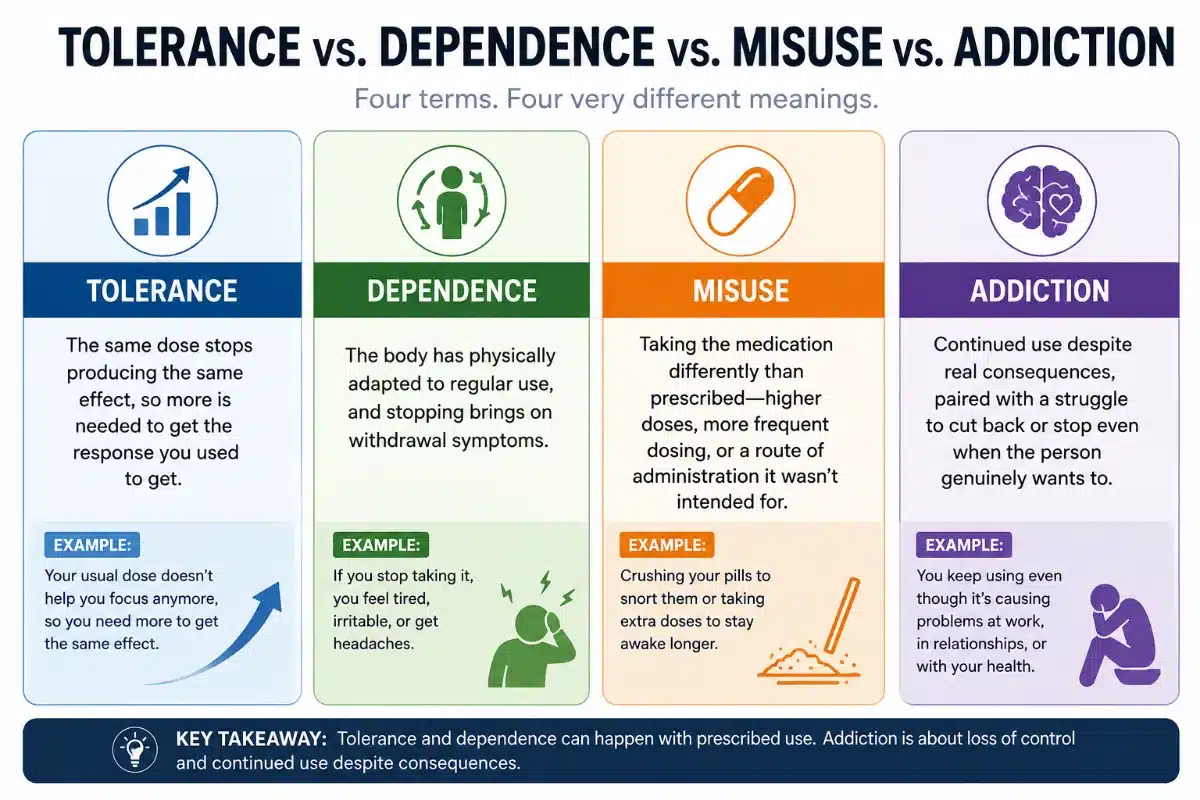
Four words get used almost interchangeably around this medication, and they shouldn’t be, because each one describes something different happening in the body or in behavior:
- Tolerance – The same dose stops producing the same effect, so more is needed to get the response you used to get.
- Dependence – The body has physically adapted to regular use, and stopping brings on withdrawal symptoms.
- Misuse – Taking the medication differently than prescribed. Higher doses, more frequent dosing, or a route of administration it wasn’t intended for, like crushing and snorting.
- Addiction – The Continuous use despite real consequences, paired with a struggle to cut back or stop even when the person genuinely wants to.
Tolerance and dependence can both happen to someone taking their medication exactly as directed. Neither one is an addiction on its own. Addiction lives in the pattern of behavior around the drug, not on the prescription label.
Clinicians don’t diagnose this on a gut feeling either. Under DSM-5-TR criteria, stimulant use disorder is rated by how many specific criteria someone meets within a 12-month period — things like failed attempts to cut down, cravings, and use that keeps causing problems at work or home. Two or three criteria are classified as mild. Four or five is moderate. Six or more is severe. That grading matters clinically, because it changes what level of treatment someone actually needs.
Warning Signs Your Methylphenidate Use May Be Becoming a Problem
Here’s what to actually watch for, since “I feel like I need it” isn’t specific enough on its own:
- Taking more than prescribed, or taking it more often than directed
- Running out of a prescription early, then scrambling for a refill or a second source
- Using it mainly for energy, productivity, or performance rather than its intended purpose
- Strong cravings, especially in the hour or two before a dose is due
- Attempting to cut back or stop and finding you can’t
- Spending an outsized amount of time thinking about, obtaining, or planning around the medication
- Continuing to use it even as sleep, relationships, work, or physical health visibly deteriorate
One or two of these in isolation don’t mean much. A cluster of them, sustained over weeks, does. Ordinary tolerance doesn’t belong on this list, and neither does taking a higher-than-average dose your doctor has specifically prescribed for your body chemistry.
How Methylphenidate Misuse Actually Starts
Most people picture stimulant misuse as buying pills off the street. That’s not how it usually happens.
The FDA’s own review of misuse literature found that the most common source of nonmedically used prescription stimulants is a friend or family member, usually given away for free rather than sold, with estimates running as high as 56 to 80 percent of cases. Most of the time, that friend or relative got the medication from a legitimate prescription in the first place.
Route matters too. Oral misuse, just taking more pills than prescribed, is by far the most common pattern, followed at a distance by nasal misuse (crushing and snorting), with injection or smoking reported only rarely. This tracks with why prescription stimulant misuse is so easy to overlook, it usually starts casually, between people who know each other, using the pill in its normal form.
What Are the Side Effects and Health Risks of Methylphenidate Misuse?
At a therapeutic, prescribed dose, methylphenidate has a fairly predictable side effect profile. Once someone pushes past that, through higher amounts, more frequent dosing, or a non-oral route, the risk profile shifts in ways that deserve a closer look.
- Sleep disruption tends to show up first and hits hardest. Methylphenidate is a stimulant, and taking it later in the day or in larger amounts pushes back sleep onset by hours in some people, not minutes. Chronic sleep loss on top of a stimulant creates its own downward spiral, since exhaustion often becomes the excuse for taking another dose.
- Appetite suppression is dose-related and can become severe with misuse. Some people lose noticeable weight over a matter of weeks, not months, and in adolescents this can interfere with normal growth patterns if it goes unaddressed.
- Anxiety and agitation climb alongside dose and frequency. Methylphenidate increases dopamine and norepinephrine activity in the brain, and at higher-than-prescribed levels that same mechanism that improves focus can tip into restlessness, irritability, or a wired feeling that doesn’t settle even at rest.
- Cardiovascular effects are where misuse gets genuinely dangerous. Elevated heart rate and blood pressure are expected even at normal doses, but they compound with higher amounts, and they compound further when methylphenidate is combined with other stimulants, including large quantities of caffeine. For anyone with an existing heart condition, this isn’t a minor side effect to shrug off.
- Mood and behavioral changes can range from irritability to, in some cases, symptoms resembling paranoia or hostility at high doses. These effects are more pronounced in people with an underlying psychiatric condition, which is part of why co-occurring mental health issues change the risk calculation so much.
Combining methylphenidate with alcohol or other substances adds a separate layer of danger, since the body ends up processing competing chemical loads at once, and the cardiovascular strain in particular gets worse, not better.
Clinical Perspective By Dr. Ash Bhatt: The question I ask every patient misusing a stimulant isn’t “how much are you taking.” It’s “what else is in the mix.” Alcohol, cannabis, someone else’s Adderall, three energy drinks a day. The methylphenidate rarely lands someone in the ER by itself. The combination usually does.
Can You Overdose on Methylphenidate?
Yes, and it’s a genuine medical emergency, not something to wait out at home.
Signs of methylphenidate overdose include:
- Severe agitation or confusion
- Tremors or uncontrolled muscle movements
- Vomiting
- A rapid or irregular heartbeat
- Dangerously high body temperature
- Hallucinations
- Seizures
- Loss of consciousness
According to MedlinePlus, even a persistent, compulsive urge to take more of the medication after already taking too much is flagged as a symptom requiring immediate medical attention, not a feeling to push through. If you see any of these signs in yourself or someone else, call 911 or get to an emergency room right away.
What Happens When You Stop Methylphenidate After Regular Use?
Stopping methylphenidate after a period of regular use, particularly at doses above what was prescribed, can trigger a withdrawal-type response while the body readjusts to functioning without it.
Symptoms commonly reported include:
- Fatigue that feels heavier than ordinary tiredness
- Disrupted sleep, either sleeping far more or far less than usual
- Low mood, sometimes intense enough to resemble clinical depression
- Trouble concentrating
- Appetite changes
- A drop in motivation
- Cravings, particularly in cases involving misuse
Here’s the complication. Someone with ADHD who stops methylphenidate may simply be experiencing the return of their underlying symptoms — the poor focus, the low energy — and those symptoms overlap almost exactly with withdrawal. Telling the two apart from the inside, without a clinician involved, is genuinely difficult.
Clinical Perspective By Dr. Ash Bhatt: Patients frequently ask me to tell them over the phone whether what they’re feeling is withdrawal or “just my ADHD coming back.” I can’t answer that without seeing them. The timeline, the specific symptom pattern, and how the two conditions historically present in that individual all matter, and that assessment has to happen in person.
Never stop methylphenidate abruptly or change your dose without medical guidance. A clinician can help distinguish withdrawal from symptom recurrence and manage either one safely.
Who’s More Likely to Misuse Methylphenidate?
Anyone taking a stimulant can misuse it. But a few factors raise the odds:
- A personal or family history of substance use. Genetic and environmental risk both play a role in how reinforcing a stimulant feels.
- A co-occurring mental health condition. Anxiety, depression, and other untreated conditions sometimes push people toward using methylphenidate to self-manage symptoms it wasn’t prescribed to treat.
- High-pressure academic or work environments. Deadlines and performance pressure are consistently reported as a top motivation for misuse, more so than getting high recreationally.
- Early exposure. Starting stimulant use young, particularly outside of medical supervision, is linked to a higher likelihood of later misuse.
- Easy access. A prescription sitting in a shared medicine cabinet, or a sibling or roommate who takes it, lowers the barrier considerably.
Why Prescription Stimulant Addiction Can Be Easy to Miss
Prescription stimulant misuse hides well, mostly because it starts with a real diagnosis and a real prescription. There’s no illicit purchase, no obvious rule-breaking to point to, just a slow drift from “as prescribed” to something else.
Rationalization does most of the covering-up. It sounds like: “I need it to get through work.” “I can’t function without it.” “I’m only taking extra when things get busy.” Each line sounds reasonable in isolation. Each one is also a small step further from the original prescription.
The prescription itself shouldn’t be the focus. What matters is whether the person still controls their use, what’s actually driving the use, and what it’s costing them — sleep, relationships, or their sense of who they are without it.
The national numbers back up how common this quiet drift is. Methylphenidate misuse specifically held at 1.2 percent of the population in 2023, essentially unchanged over the past decade despite periodic shortages and steady prescribing rates. Broader prescription stimulant misuse affected an estimated 3.9 million Americans aged 12 and older that same year, and most of that misuse happened inside otherwise legitimate treatment, not outside it.
When Is It Time to Get Help for Methylphenidate Use?
Certain patterns point clearly toward needing professional support rather than trying to manage things alone:
- Difficulty controlling how much or how often you use the medication
- Repeated misuse, even after telling yourself it would be a one-time thing
- Persistent cravings between doses
- Continuing use despite clear consequences at work, school, or home
- Using other substances, including alcohol, alongside methylphenidate
- Worsening anxiety, depression, or other mental health symptoms
- Relationships showing visible strain tied directly to medication use
Effective treatment looks at the whole person, not just the substance in question. That’s especially true when ADHD, anxiety, depression, or another condition exists alongside stimulant misuse, since treating one without the other rarely holds up.
At our Legacy Healing Center prescription drug addiction treatment programs are built around that fuller picture, with stimulant addiction treatment addressing the specific patterns tied to medications like methylphenidate. When a co-occurring mental health condition is part of the picture, dual diagnosis treatment treats both at once, rather than one after the other.
Conclusion
Methylphenidate does real good for the people it’s meant to help, and it carries real risk when that changes. The two facts aren’t in tension. Most people on this medication never misuse it. Some do, and it’s rarely a dramatic turn, it’s a slow drift that starts with a shared pill, an extra dose before a deadline, a habit of running out early.
What decides the outcome isn’t the diagnosis, the dose, or how long someone’s been prescribed it. It’s whether the person is still in control, and whether they, or someone who loves them, is willing to name it early rather than late. If any of what’s described here sounds familiar, that’s worth a conversation with a doctor, not a search engine.