




-
 By:
Valerie Puffenberger, PMHNP-BC
By:
Valerie Puffenberger, PMHNP-BC -
Editor:
Phyllis Rodriguez, PMHNP-BC
-
Clinical Reviewer:
Dr. Ash Bhatt, MD, MRO
 By:
By:
 Editor:
 Clinical Reviewer:
If you have ever googled “how long does Adderall stay in your system,” the chances are you are not just curious, but rather want to figure out the reason behind it. Maybe you have a drug test coming up or maybe you are concerned about a family member’s use. The thing is, the answer is not universal, and that is exactly why this manual is here to help you.
Your Adderall’s detectability window depends on the type of drug, the dosage, metabolic rate, the age, kidney and liver function.
In this article, we will walk through each testing method, break down the factors that affect how long Adderall stays in your system, answer dose-specific questions about 10 mg, 20 mg, and 30 mg, and explain when Adderall use can shift from medical to concerning.
Key Takeaways
- Adderall lasts in your system in two separate ways: you can feel its impact for about 4-12 hours but the drug is still detectable in your body for a longer period, for instance, a urine test can find traces of it 24 days after your last dose.
- Unfortunately, there is no way to trick your body into flushing out Adderall faster, whether it is detox drinks, excessive water, or supplements, they cannot reliably speed up how your kidneys process amphetamine salts. Because it’s your metabolism that sets the pace.
- When someone is taking Adderall without a prescription, increasingg their dose, or are unable to stop, it definitely deserves the structured treatment plan as any other substance use disorder.
How Long Does Adderall Stay in Your System?
Here is a reference table for detection windows across the most common drug testing methods. Do keep in mind that these figures are only the average values. Your exact result may be different.
| Test Type | Approximate Detection Window |
| Blood | Up to 24–34 hours |
| Saliva | 20–50 hours |
| Urine | 2–4 days (sometimes longer with chronic use) |
| Hair | Up to 90 days |
Note: The detection time is merely a rough estimate and depends on various factors like dose metabolism, how often you use the drug, urine pH, etc. These windows only show the time period within which the drug is traceable in your body and do not indicates the long term effect of Adderall will last.
What Is Adderall?
Adderall is a prescription stimulant medication composed of mixed amphetamine salts, specifically a 3:1 ratio of d-amphetamine (dextroamphetamine) and l-amphetamine. It acts by inhibiting the reabsorption of norepinephrine and dopamine in the brain, which raises the levels of these two neurotransmitters. Personally, this action helps the brain of people with ADHD work better in areas that are involved in focus, impulse control, and attention. But, when the same mechanism takes place in the brain of a person without ADHD, it produces stimulant effects resulting in enhanced energy and cognitive sharpening, which is the very reason why many people resort to the use of Adderall.
The FDA has approved Adderall for the treatment of two main disorders: attention deficit hyperactivity disorder (ADHD) and narcolepsy which is a sleep disorder. Any application of Adderall other than these is considered off-label and so the use of it without a prescription is illegal under federal law.
Adderall is a drug that the DEA has listed as Schedule II controlled substance, which is the same category as the drugs oxycodone and fentanyl. This ranking by the DEA is a result of the drug’s potential for dependence that is very high and the serious health risks that may accompany the misuse of the drug. It does not necessarily mean that it is a dangerous drug if used strictly based on the prescription but it definitely shows why it is under tight regulation and why the misuse of it might cause real serious consequences.
How Long Does Adderall Last?
There is an important distinction that most people mix up: how long Adderall’s effects last and how long the drug remains in your body. These are two different issues, and the difference is much bigger than what most people think.
Adderall comes in two formulations, and the one you take changes a lot in how long you feel its effects:
- Adderall IR (Immediate-Release): Usually, effects come on within 30-60 minutes after the medication, and the highest drug level in the blood is reached after around 3 hours. The therapeutic window for most people is 4-6 hours, so IR usually means needing to take the drug several times a day for coverage for the whole day..
- Adderall XR (Extended-Release): Uses a dual-bead technology, one set releases 50% of the dose immediately, and the other set releases the remaining 50% after about four hours. This results in a biphasic effect profile from a single morning dose that lasts 10-12 hours, so most people won’t need to dose in the middle of the day.
According to FDA pharmacokinetic data, the average elimination half-life of d-amphetamine in adults is roughly 10-12 hours, whereas l-amphetamine has a somewhat longer half-life of about 13 hours. Half-life means the time when half of a drug dose is removed from the blood, not the time when the drug effects cease.
Medical Advice by Dr. Ash Bhatt, CMO, Legacy Healing Center
I explain this to patients regularly: just because Adderall has “worn off” does not mean it is gone from your system. The effects you will feel depend on active blood levels hitting certain thresholds, while drug tests detect the presence of amphetamine metabolites, a different measure entirely. A patient whose last dose was three days ago can still test positive on a urine screen, which surprises a lot of people.
How Long Does Adderall Stay in Your System by Drug Test?
The length of time Adderall can be detected in your system depends a lot on what kind of biological sample is tested. Here is a chart of each technique:
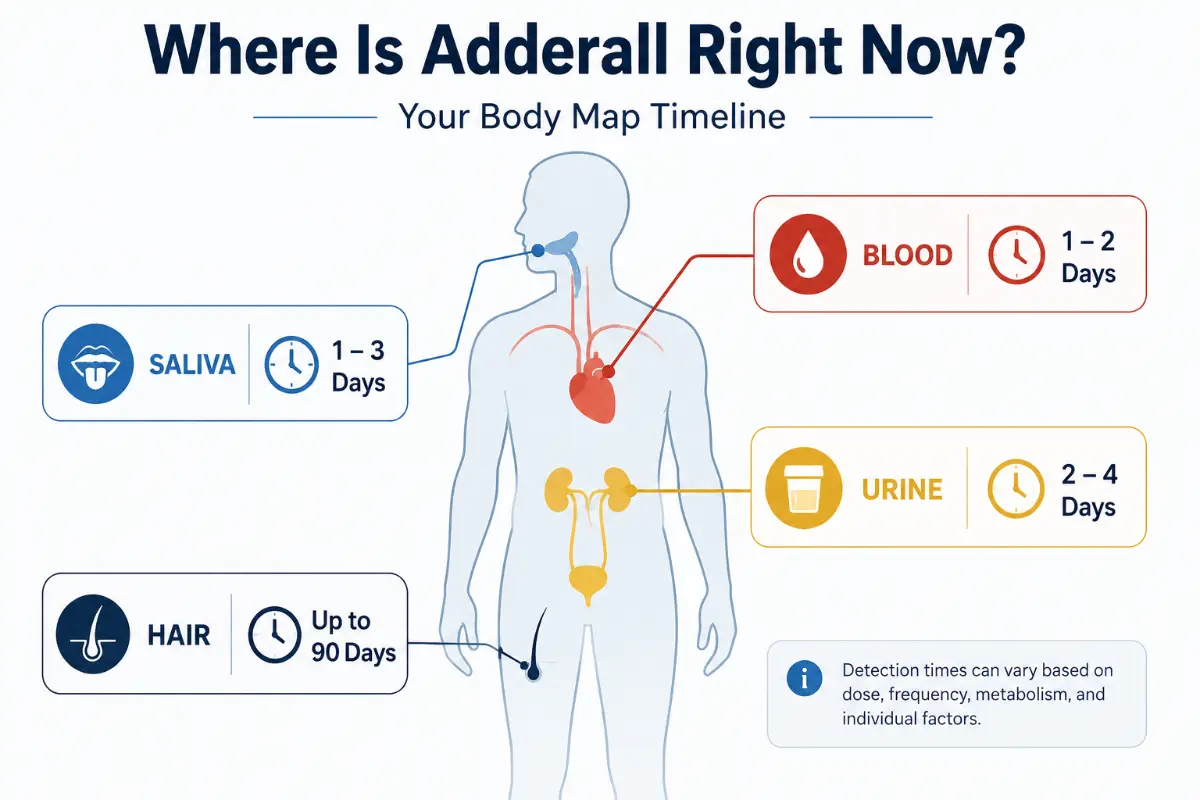
1. Urine Test
In fact, urine testing is the most popular method for Adderall detection during drug testing at work, in court, or for medical purposes. It picks up d-amphetamine and l-amphetamine as well as their metabolites, which linger in the urine longer than the drug itself.
For someone taking Adderall once in a while or only once, it is generally possible to find traces of the drug in urine for 2 – 4 days following the last consumption. Yet, if the drug is taken regularly and/or in large doses, the window of detection can be increased up to 7 days. Besides, the pH level of urine also affects the process quite a lot: acidic urine (low pH) results in faster elimination of amphetamines, while alkaline urine leads to slower excretion. This is a very important factor because certain foods and drugs can change the urine pH.
2. Blood Test
Since blood test can measure the amount of drug present in the bloodstream, this method has the shortest detection window compared to others. In fact, Adderall can be found in blood plasma for only 7-34 hours after the last dose. Still, the large variation is due to differences in metabolism and urine pH among individuals.
Because blood testing involves drawing blood from a vein and due to the very short detection period, these tests are usually not performed in routine drug testing at workplaces. Instead, they are normally carried out in emergency medical situations or times when one needs to prove that the drug was consumed very recently. Besides, blood testing can tell you what is present in a person’s body now, but not what they consumed last week.
3. Saliva Test
Oral fluid (saliva) testing is able to reveal the presence of Adderall as quickly as 20 minutes after the drug has been taken, which makes it one of the quickest methods for detecting drugs. The period of time during which Adderall can be detected using oral fluid testing normally ends 20-50 hours after the last dose; However, some tests that are used for confirmation purposes have found the drug up to 72 hours later.
The detection success rate may vary according to factors like oral hygiene hydration salivary flow, and urine pH; the same dynamic in urine pH that influences the urinary excretion of substances also affects the rate at which amphetamine is eliminated from oral fluid.
4. Hair Test
Hair follicle analysis offers a detection window that is the longest of any drug testing method. When blood flows through the scalp, drug metabolites are introduced into the hair shaft as it grows, a process that happens at a pace of about half an inch per month. Usually, a hair test uses a 1. 5-inch hair sample which equals approximately 90 days of drug history.
Hair testing isn’t intended for detecting recent drug use or current impairment, but rather works as a record of past drug use. Also, if you were to touch Adderall and then touch your hair, this scenario of external contamination is not likely to result in a positive drug test when proper washing procedures are followed.
Factors That Affect How Long Adderall Stays in Your System
Detection windows are averages, not absolutes. Several physiological and behavioral factors can push the timeline shorter or longer:
1. Dosage
Higher doses mean a greater total amount of amphetamine that the body needs to metabolize and excrete. Normally, a 30 mg dose would stay in the body longer than a 10 mg dose because there is more drug to be processed, not because the detection window category changes. Yet, the difference between doses is not significant from the detection point of view; a 30 mg dose does not raise the urine detection window by days, it only increases the time of clearance by hours.
2. Immediate-Release vs. Extended-Release
Although both IR and XR have the same amphetamine salts, the way their release mechanisms work contributes to the difference in the timing of peak blood concentration. Adderall XR reaches a lower Cmax (maximum concentration) than taking the same dose of IR all at once, since XR dose is spread out over time. This may affect total plasma exposure, though both dosage forms remain in urine approximately the same 2-4 day detection window after the last dose.
3. Metabolism
Individual metabolic rate is one of the most variable factors. The CYP2D6 enzyme, part of the cytochrome P450 system in the liver, plays a significant role in amphetamine metabolism. Genetic variations mean some people are poor metabolizers (slower clearance, higher drug levels) and others are extensive metabolizers (faster clearance).
4. Age
According to FDA pharmacokinetic data, children 6-12 years old tend to eliminate amphetamine roughly 12 hours faster than adults after a single dose. Yet, if the dose is not adjusted as body weight, they end up with higher systemic exposure. In elderly people, slowed metabolism and reduced kidney function can cause really longer clearance times.
5. Kidney and Liver Function
Adderall is mainly metabolized in the liver (through CYP2D6) and excreted via the kidneys. Liver impairment decreases the formation of inactive metabolites from amphetamine, and kidney impairment slows the elimination of these metabolites in the urine. Both situations can increase the duration of the drug’s detectability. Patients with chronic kidney disease or liver disorders must inform their doctors about these conditions.
6. Frequency of Use
The pattern of drug clearance is different between infrequent use and daily use. When a person uses the drug regularly, amphetamine may build up in the tissues, and the total elimination time may be longer. For example, a daily user of Adderall at a normal therapeutic dose may take more time to produce a negative drug test result compared to someone who has taken a single dose for the first time. This issue comes up most noticeably with urine testing, where chronic consumption often means detection windows of 7 days or more.
Does Adderall Stay Longer in Your System Based on the Dose?
This is one of the most commonly searched questions, so let us address it directly. People often search for specific answers around how long does Adderall stay in your system at 10 mg, 20 mg, or 30 mg, and the honest answer is that dose affects clearance time, but it does not create entirely separate detection windows.
Here is how to think about it by dose:
- 10 mg: A lower dose means less total amphetamine entering the body. At this level, clearance is typically on the faster end of the 2-4 day urine window, particularly for people without existing Adderall tolerance.
- 20 mg: A standard mid-range dose for adults. Clearance falls in the expected 2-4 day urine range, with individual variation based on metabolism and kidney function.
- 30 mg: The maximum commonly prescribed adult dose. Higher total drug load means the body has more to process. Clearance may sit at the longer end of the detection range, and with frequent use at this level, the window can extend closer to 7 days in urine.
Can You Speed Up the Process?
No, unfortunately there’s no effective method to fasten how fast Adderall is eliminated from your body. Many sources online talk about different detox drinks, hydration techniques, and supplement plans, but none of these really work the way people think they do, and some can actually cause problems.
Here is what people commonly try, and what actually happens:
- Drinking excess water won’t speed up the breakdown of amphetamines. It only dilutes the urine, which may cause the metabolite concentration to temporarily fall below the detection level of a test, but labs are well aware of diluted samples and in fact some testing officials might even ask for a new sample.
- Detox drinks are completely unregulated and lack clinical basis. Basically, as far as drug removal is concerned, they mostly operate on the same dilution mechanism as water, with a great deal of marketing hype added. The FDA does not recognize any product making drug clearance claims.
- Exercise is often suggested because it boosts metabolism. But, in reality, rigorous workout activities may cause amphetamines that are stored in fat cells to be released into the blood, which could make the drug detectable for a longer time instead of a shorter one.
- Vitamin C and acidic foods have a grain of pharmacological truth: acidic urine does enhance amphetamine excretion. But, the change is very slight and variable, and even if it is, the detection period cannot be shifted much. So it is definitely not a tactic.
When Does Adderall Use Become a Concern?
According to the National Survey on Drug Use and Health, an estimated 3.9 million Americans aged 12 and older misused prescription stimulants in 2023, and Adderall is consistently the most commonly misused prescription stimulant in studies across multiple college campuses and demographic groups.
Warning signs that Adderall use may have crossed into problematic territory include:
- Taking higher doses than prescribed, or taking doses more frequently than directed.
- Using Adderall obtained from someone else’s prescription rather than your own.
- Experiencing cravings or a strong urge to take Adderall even when you do not “need” it for focus.
- Doctor shopping – visiting multiple providers to obtain additional prescriptions.
- Feeling unable to function, concentrate, or get through the day without Adderall.
- Mixing Adderall with alcohol or other substances to enhance its effects or manage the comedown.
- Continuing to use despite noticing negative effects on sleep, appetite, heart rate, or mood.
Related Read: Signs of Adderall Abuse
Treatment for Adderall Misuse and Addiction
Recognizing that Adderall use has shifted from functional to problematic addiction signs is the hardest part. What comes after that is more straightforward than most people expect.
Treatment typically begins with a medical evaluation, an assessment of how long and how heavily Adderall has been used, whether withdrawal symptoms are likely, and what level of care is actually appropriate. From there, a few different paths exist depending on where someone is:
Medical detox is often the starting point for people with significant dependence. Stopping Adderall abruptly can bring on fatigue, depression, difficulty concentrating, and disrupted sleep. A supervised detox manages those symptoms and keeps someone stable during the most vulnerable window.
Inpatient treatment provides around-the-clock support in a residential setting, useful for people who need full separation from the environment where use was happening.
Outpatient programs (including PHP and IOP) allow someone to engage in structured treatment while maintaining work or family responsibilities. These work well when there is a solid support system at home.
Behavioral therapy, particularly cognitive-behavioral therapy, is the most evidence-backed approach for stimulant use disorders. It addresses the thought patterns driving use and builds practical skills for staying off the medication.
Aftercare – whether that is continued therapy, support groups, or alumni programming, bridges the gap between treatment and long-term recovery.
If you recognize yourself or someone you care about in any of what you have read here, reaching out for an evaluation is a good first step, not a last resort. Call Legacy Healing Center today and speak with someone who can help you figure out what the next step looks like for you specifically.