



-
 By:
Valerie Puffenberger, PMHNP-BC
By:
Valerie Puffenberger, PMHNP-BC -
Editor:
Phyllis Rodriguez, PMHNP-BC
-
Clinical Reviewer:
Dr. Ash Bhatt, MD, MRO
 By:
By:
 Editor:
 Clinical Reviewer:
Alcohol, cocaine, and sexual behavior can become linked in ways that make each one harder to control. For some people, drinking lowers inhibitions, cocaine adds stimulation and prolongs a binge, and sexual activity becomes strongly associated with the intoxicated state. Over time, one part of the pattern may begin triggering cravings for the others.
This is one way alcohol, cocaine, and sex addiction may appear to overlap, but the terminology requires care. Increased sexual desire or risky sexual behavior while intoxicated does not automatically mean someone has a separate “sex addiction.” Clinicians are more concerned with patterns such as loss of control, repeated unsuccessful efforts to stop, continuing despite consequences, and whether problematic sexual behavior also occurs outside periods of intoxication.
The most important issue is often not whether a person has three separate addictions. It is whether alcohol use, cocaine use, sexual behavior, and the emotional aftermath of these episodes have become part of the same self-reinforcing cycle.
Why Can Alcohol, Cocaine, and Sexual Behavior Become Linked?
Alcohol, cocaine, and sex can become linked when they are repeatedly experienced together and begin functioning as cues for one another. A person may initially combine them occasionally, but repeated pairing can make drinking trigger thoughts of cocaine or sex, cocaine trigger sexual urges, or sexual situations trigger expectations of drinking and drug use.
The process may start without any deliberate intention to create such a connection.
Someone may initially drink in a social setting and then use cocaine because it is available. Cocaine may increase energy, confidence, stimulation, or sexual desire for some people. Alcohol may simultaneously reduce inhibition and weaken judgment about decisions the person would make differently while sober.
Sex then becomes part of the intoxicated experience.
When this sequence is repeated, the association may strengthen. Eventually, the anticipation of one part of the experience, the first drinks, a particular social environment, meeting a sexual partner, opening an app, watching pornography, or obtaining cocaine, may generate urges for the rest.
This helps explain why a person can sincerely intend to “just have a few drinks” yet repeatedly end up using cocaine and engaging in sexual behavior they had not planned.
The pattern is not inevitable. Many people who drink alcohol, use cocaine, or have active sex lives never develop this cycle. The concern is repeated pairing accompanied by increasing difficulty controlling what happens next.
What Does the Alcohol-Cocaine-Sex Cycle Look Like?
A reinforcing cycle often develops gradually: experimentation becomes repetition, repetition creates stronger associations, and those associations begin influencing future behavior.
One possible progression looks like this:
Experimentation → drinking → cocaine use → greater stimulation and disinhibition → sexual activity → prolonged or repeated use → consequences → emotional distress → renewed urges to drink, use cocaine, or seek sexual stimulation
At first, the person may experience the combination as recreational.
They might primarily use cocaine when drinking at parties or during sexual encounters. The fact that cocaine use is limited to those situations can even create a sense that it is controlled: I don’t use cocaine during the week, so it isn’t really a problem.
But frequency alone does not determine severity.
An episodic pattern can still involve major loss of control if drinking reliably turns into cocaine use, planned limits repeatedly disappear, binges become longer, sexual boundaries change while intoxicated, or the person continues despite mounting consequences.
Eventually, the behaviors can become difficult to separate.
A person may notice that sex without cocaine feels less exciting, that drinking creates an immediate desire to obtain cocaine, or that cocaine use almost automatically leads to pornography, masturbation, hookups, or prolonged sexual activity.
At that point, the problem is no longer simply that several behaviors occur on the same night. Each part of the sequence may be helping activate the next.
Alcohol and Cocaine Can Play Different Roles in the Same Cycle
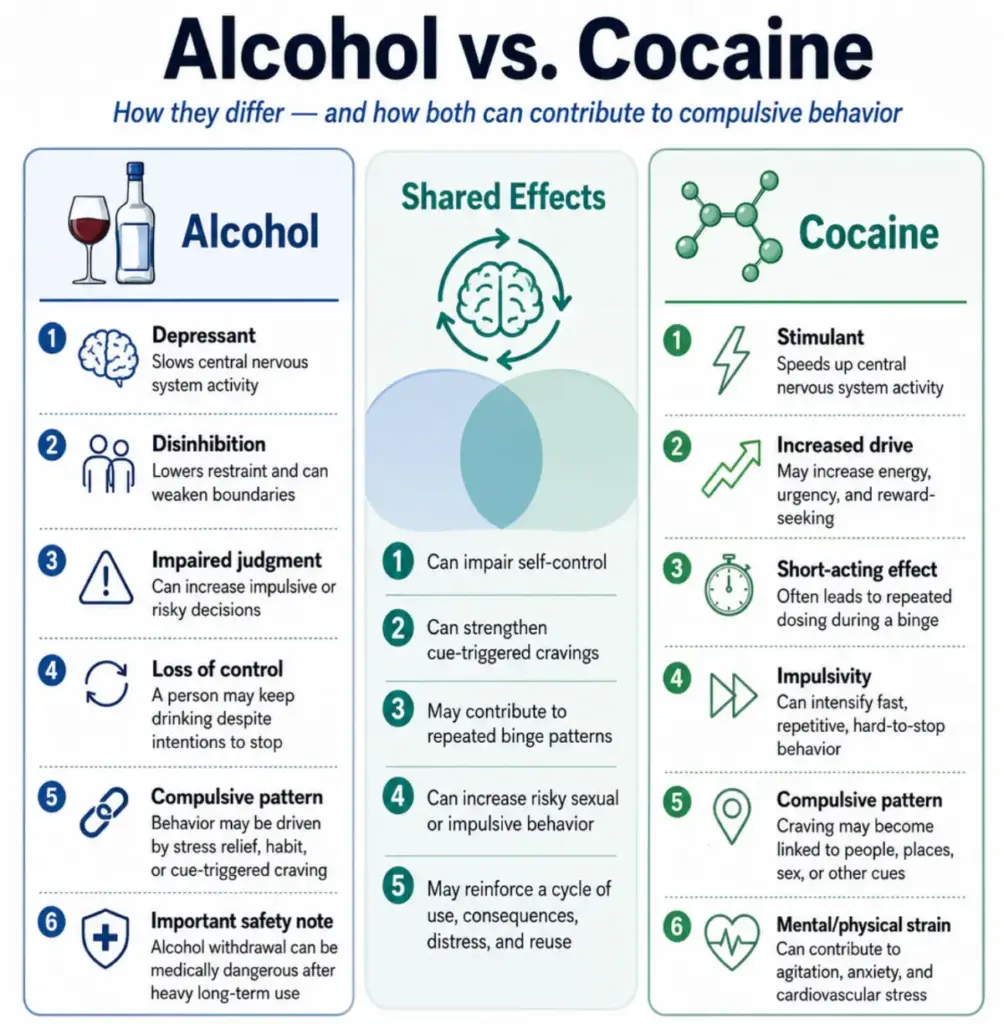
Alcohol and cocaine do not affect people identically, but their different effects can combine in ways that encourage longer and riskier behavioral episodes.
| Part of the pattern | How it may influence the cycle |
|---|---|
| Alcohol | Can reduce inhibition, impair judgment, increase willingness to take risks, and make consequences seem less important in the moment. |
| Cocaine | May increase stimulation, confidence, wakefulness, impulsivity, and sexual desire in some people while encouraging repeated dosing and longer periods of activity. |
| Sexual behavior | May become strongly associated with intoxication, excitement, relief, validation, or escape and eventually act as a cue for alcohol or cocaine use. |
| The combined pattern | Drinking, cocaine, sex, environmental cues, and emotional states may begin triggering one another, making the complete sequence increasingly automatic. |
Research supports parts of this relationship.
In an experimental study of people who used cocaine, cocaine administration increased sexual desire and altered hypothetical sexual decision-making, including willingness to wait for a condom. The study was small, so it should not be generalized to every person who uses cocaine, but it provides evidence that cocaine itself can influence both sexual motivation and decision-making.
Alcohol has similarly been associated with sexual risk-taking. In one study of 308 young adults recruited from New York City nightlife settings, 62% reported recently having sex while under the influence, and 29% of those participants believed they had behaved less safely sexually because of their drinking. The study describes an association rather than proving that alcohol caused every risky decision, but it illustrates why social context and intoxication matter.
The important takeaway is not that alcohol or cocaine automatically causes compulsive sexual behavior. It is that both substances can alter the conditions under which sexual decisions are made, and repeated experiences can strengthen the connection among the behaviors.
Why Is Combining Alcohol and Cocaine Particularly Risky?
Using alcohol and cocaine together creates risks beyond the behavioral cycle because the body can form cocaethylene, an active metabolite produced when cocaine and alcohol are present together.
Cocaethylene lasts longer than cocaine and may increase cardiovascular danger. A 2024 systematic review concluded that simultaneous alcohol and cocaine use creates additional risk of cardiovascular fatalities compared with cocaine alone, although findings for some individual cardiovascular outcomes remain inconsistent.
A separate review of cocaethylene notes that it may prolong or intensify psychoactive effects while contributing to cocaine-related cardiovascular problems.
For someone caught in an alcohol-cocaine-sex cycle, this matters because the behavioral pattern can encourage extended episodes.
A person may continue drinking while repeatedly using cocaine, remain awake much longer than expected, and continue sexual activity for hours. Impaired judgment can make it difficult to recognize how intoxicated or physically compromised they have become.
That combination can increase exposure to several forms of harm at once, including cardiovascular emergencies, accidents, interpersonal conflict, sexual-health risks, dehydration, severe anxiety or agitation, and decisions the person would not ordinarily make while sober.
Chest pain, seizures, severe confusion or agitation, loss of consciousness, difficulty breathing, or other signs of a medical emergency require immediate medical attention.
Does Cocaine-Induced Hypersexuality Mean Someone Has a Sex Addiction?
No. Feeling unusually sexual while using cocaine does not by itself establish compulsive sexual behavior disorder or a separate behavioral addiction.
This distinction is particularly important for this topic.
The World Health Organization’s ICD-11 recognizes compulsive sexual behavior disorder (CSBD) as an impulse-control disorder characterized by persistent difficulty controlling intense, repetitive sexual urges or behaviors that cause meaningful impairment or distress.
Importantly, guidance surrounding CSBD specifically cautions against diagnosing the disorder when the sexual behavior is entirely attributable to the direct effects of substances such as cocaine.
That means clinicians may ask questions such as:
- Does the loss of control occur only when the person is intoxicated?
- Does compulsive sexual behavior continue during extended periods of sobriety?
- Has the person repeatedly tried and failed to reduce the behavior?
- Is sexual behavior becoming a central focus at the expense of work, relationships, health, or other responsibilities?
- Does the behavior continue despite significant consequences?
- Is distress primarily coming from actual loss of control and impairment, or from moral or personal disapproval of otherwise controlled sexual behavior?
A high libido is not the same as a disorder.
Neither are frequent masturbation, pornography use, multiple partners, or unconventional sexual interests by themselves. The clinical concern is persistent impaired control combined with significant consequences or functional impairment.
This is one reason the popular terms “sex addiction,” “hypersexuality,” and “compulsive sexual behavior” should not be treated as exact synonyms.
How Does Recreational Pairing Become a Compulsive Pattern?
The transition becomes concerning when the combination starts dictating behavior rather than merely accompanying it.
Imagine someone who initially uses cocaine several times a year while drinking with friends. Sex occasionally follows. Months later, they notice that once they reach a certain point while drinking, they almost always start thinking about cocaine.
Cocaine then increases the likelihood of pursuing sexual stimulation. What had originally been an occasional sequence now becomes predictable.
The person may start planning only the first step while implicitly expecting the rest.
They tell themselves they are going out for drinks but carry extra money because cocaine will probably become involved. They arrange a sexual encounter before the evening begins. Or they promise themselves they will use cocaine but avoid sexual situations, only to repeat the same behavior once intoxicated.
This is where cue-triggered craving becomes particularly relevant.
The cue may not be cocaine itself. It can be:
- alcohol
- a nightclub or hotel
- being alone after drinking
- a specific partner
- certain messaging or dating apps
- pornography
- particular music or social settings
- having access to money
- loneliness, rejection, stress, or conflict
Over time, removing only one cue may not eliminate the larger behavioral network that has developed around it.
Warning Signs the Cycle Is Escalating
The strongest warning signs involve loss of control and increasing consequences, not simply the presence of alcohol, cocaine, or frequent sexual activity.
A pattern deserves closer attention when someone notices:
- Drinking increasingly leads to cocaine use even when cocaine was not planned.
- Cocaine increasingly triggers sexual behavior that feels difficult to interrupt.
- Sex, pornography, or masturbation begins triggering cravings for cocaine or alcohol.
- Episodes last significantly longer than intended.
- More alcohol or cocaine is being used over time.
- The person repeatedly sets rules, such as no cocaine tonight or no hookups while using, and breaks them.
- Sexual boundaries or risk tolerance change substantially during intoxication.
- Work, family responsibilities, finances, sleep, or relationships are being disrupted.
- Increasing amounts of time are spent obtaining substances, arranging sexual encounters, participating in the episode, or recovering afterward.
- The person hides the extent of the behavior from a partner or family.
- The behavior continues despite health scares or significant relationship consequences.
- Attempts to stop one component repeatedly lead to substitution with another.
- Shame, loneliness, anxiety, or stress after a binge becomes a reason to drink, use cocaine, or seek sexual stimulation again.
Being able to abstain for several days or weeks does not automatically rule out a serious problem. Some substance use disorders and compulsive patterns occur episodically, with relatively calm intervals between intense binges.
The better question is: What happens once the cycle begins?
Why Can Shame and Consequences Make the Pattern Worse?
Consequences can paradoxically become fuel for the next episode when substances or sexual behavior are also being used to escape uncomfortable emotions.
An episode may end with relationship conflict, money spent unexpectedly, missed responsibilities, physical exhaustion, sexual regret, anxiety, or embarrassment.
The next day, the person may genuinely want to stop.
But the emotional consequences of the previous episode can produce exactly the states they have learned to escape through alcohol, cocaine, or sexual stimulation: loneliness, shame, stress, rejection, boredom, anger, or emotional numbness.
That creates a second reinforcement loop:
Episode → consequences → distress → desire for relief → substance use or sexual behavior → temporary escape → additional consequences
This does not mean shame “causes addiction.” It means that once alcohol, cocaine, or sexual behavior becomes a reliable method of changing an emotional state, the consequences of previous episodes can become triggers for future ones.
This is also why purely moralistic responses tend to miss the clinical problem. Increasing someone’s shame does not necessarily increase control.
Understanding what happens before, during, and after the episode is much more useful.
Can Someone Have Cocaine Addiction and Compulsive Sexual Behavior at the Same Time?
Yes, co-occurring cocaine use disorder and compulsive sexual behavior can occur, although researchers are still clarifying how frequently and through what mechanisms.
A 2024 study examining people receiving inpatient treatment for substance use disorders found no clear evidence that CSBD was universally more common in the substance-use group than in controls. That is an important reminder not to assume that substance addiction automatically produces a compulsive sexual disorder.
At the same time, research published in 2026 specifically examining people with cocaine use disorder found clinically meaningful differences among participants who screened positive for compulsive sexual behavior. Those participants showed greater impulsivity and emotion-regulation difficulties, and probable compulsive sexual behavior at treatment entry was associated with poorer completion of the inpatient phase of treatment. The authors suggested that screening for compulsive sexual behavior and emotion-regulation problems may improve management of cocaine use disorder.
These findings reinforce an important point: co-occurrence is possible, but clinicians should assess it rather than assume it.
How Do Clinicians Evaluate Alcohol, Cocaine, and Sexual Behavior Together?
A useful evaluation looks at the sequence and relationship among the behaviors rather than asking only how much someone drinks, how often they use cocaine, or how often they have sex.
A clinician may reconstruct typical episodes from beginning to end.
For example:
What usually happens first?
Does drinking precede cocaine nearly every time? Does cocaine immediately create an urge for sex? Does compulsive sexual behavior occur during sobriety? What emotional state preceded the episode? What consequences followed it? What happened the next time the person experienced those emotions?
Assessment may also examine:
- alcohol and cocaine frequency, quantity, cravings, tolerance, and loss of control
- whether alcohol withdrawal could occur if drinking stops
- whether sexual behavior is primarily substance-induced or continues while sober
- unsuccessful attempts to reduce any of the behaviors
- relationship, occupational, financial, legal, or health consequences
- impulsivity and emotional regulation
- depression, anxiety, trauma symptoms, mania, or other psychiatric symptoms when clinically relevant
- medications or medical conditions that could affect behavior
- sexual-health concerns
- immediate safety risks
- environmental and interpersonal triggers
The objective is not to label every behavior as an addiction.
It is to discover which parts of the sequence are driving the others.
Why Treating Only the Cocaine May Not Be Enough
If alcohol, cocaine, and sexual behavior have become strongly linked, focusing on only one component can leave important relapse triggers untouched.
Someone may stop cocaine but continue heavy drinking in the same settings where cocaine use previously occurred. Once intoxicated, the familiar craving for cocaine can return.
Another person may stop drinking but continue seeking the sexual situations that had repeatedly been paired with cocaine. Those situations may trigger intense drug cravings.
Someone with a persistent compulsive sexual behavior pattern may stop cocaine yet continue using sexual stimulation to manage loneliness, stress, or difficult emotions.
This does not mean everyone needs separate treatment programs for three different addictions.
It means treatment planning should account for the functional relationship among the behaviors.
A relapse-prevention plan that says only “avoid cocaine” may be incomplete if the person’s actual pattern is:
work stress → drinking → cocaine → sexual binge → shame → isolation → drinking again
In that situation, several points in the chain may need attention.
What Can Treatment Address When the Behaviors Are Intertwined?
Treatment can address substance use, sexual behavior, triggers, emotional regulation, and relapse patterns within one coordinated plan rather than assuming every problem operates independently.
The exact level of care depends heavily on severity.
Someone who is medically unstable or at risk from alcohol withdrawal may need medical stabilization before longer-term behavioral work can begin. Alcohol withdrawal can become life-threatening in people who have been drinking heavily and chronically, which is why suddenly stopping without appropriate medical evaluation can be dangerous.
After immediate medical needs are addressed, treatment may focus on several interconnected areas.
Substance-use treatment may address alcohol and cocaine cravings, high-risk situations, coping skills, and relapse prevention. Behavioral therapies such as cognitive behavioral approaches and motivational interviewing are among the evidence-based approaches SAMHSA identifies when evaluating quality treatment programs.
For alcohol use disorder, a clinician may also consider FDA-approved medication when appropriate. There are currently no FDA-approved medications specifically for preventing return to cocaine use, making behavioral treatment particularly important in cocaine use disorder.
Behavioral analysis can help identify the sequence connecting substances with sexual behavior. Rather than treating a relapse as one unexplained event, the person and clinician examine the chain of decisions, emotions, cues, environments, and cravings that led to it.
Compulsive sexual behavior treatment, when clinically indicated, may focus on improving control, understanding triggers, changing repetitive behavioral patterns, managing urges, and rebuilding healthy sexuality rather than promoting sexual shame or abstinence from sexuality itself.
Mental health treatment may also matter when depression, anxiety, trauma symptoms, impulsivity, or other conditions are directly contributing to the cycle.
The most useful treatment plan is therefore often less about separating the problem into categories and more about understanding how the person’s actual cycle works.
What Should a Partner or Family Member Look For?
Partners and relatives often notice changes in patterns before they know exactly what is happening.
They may see unexplained disappearances, drastic changes in sleep, financial irregularities, secrecy surrounding phones or social activities, escalating drinking, unusual periods of stimulation followed by crashes, missed commitments, or repeated promises that the behavior will not happen again.
No single behavior proves cocaine addiction, alcohol use disorder, or compulsive sexual behavior.
What matters is the broader pattern.
Repeated cycles of intoxication, secrecy, sexual behavior, remorse, promises to stop, and recurrence deserve attention, particularly when the person experiences significant medical, relationship, financial, or occupational consequences.
A productive conversation usually focuses more on observable behavior than labels.
For example, discussing repeated cocaine use after drinking, missed responsibilities, medical concerns, or failed attempts to stop is more useful than arguing over whether someone is technically a “sex addict.”
When Is It Time to Seek Professional Help?
Professional evaluation becomes increasingly appropriate when alcohol, cocaine, or sexual behavior repeatedly produces loss of control, significant consequences, medical risk, or failed attempts to change.
You do not need to determine beforehand whether the correct diagnosis is alcohol use disorder, cocaine use disorder, compulsive sexual behavior disorder, another mental health condition, or some combination.
That is part of the evaluation.
Consider seeking help when:
- alcohol or cocaine use is becoming more frequent or intense
- drinking reliably triggers cocaine use
- substance use repeatedly leads to sexual situations the person later regrets
- attempts to stop or establish limits repeatedly fail
- episodes are becoming longer or harder to interrupt
- work, finances, health, or relationships are being affected
- sexual behavior feels difficult to control even when sober
- significant anxiety, depression, paranoia, or emotional instability follows binges
- alcohol withdrawal may be a concern
- the person continues despite serious medical or interpersonal consequences
A professional who understands both substance use disorders and compulsive behavioral patterns can help determine whether the sexual behavior is primarily substance-induced, represents an independent compulsive pattern, or falls somewhere between those possibilities.
That distinction matters because it changes what treatment needs to target.
The Most Important Question Is Whether the Behaviors Have Become Connected
Alcohol, cocaine, and sexual behavior do not need to become three independent addictions to create a serious problem.
For some people, the central issue is the relationship among them.
Alcohol lowers barriers. Cocaine adds stimulation or prolongs the episode. Sexual activity becomes associated with intoxication. Repeated pairing strengthens cues. Consequences create distress. Distress becomes another reason to drink, use cocaine, or seek sexual stimulation.
Eventually, the person may have difficulty engaging in one behavior without triggering another.
Recognizing this sequence can be more useful than debating which behavior is the “real” problem.
If you are noticing that drinking, cocaine, sex, pornography, or masturbation increasingly trigger one another, or that the same cycle continues despite repeated attempts to stop, an integrated professional assessment can help identify where the pattern begins and what needs to change.
For broader information about alcohol-related patterns and treatment, see our Alcohol Addiction resource.
For help locating substance-use or mental health treatment in the United States, SAMHSA’s FindTreatment.gov offers a confidential treatment locator, and SAMHSA’s National Helpline is available 24/7 at 1-800-662-HELP (4357).
If substance use or the emotional aftermath of an episode is accompanied by suicidal thoughts, severe emotional distress, or a mental health crisis, call or text 988 for the 988 Suicide & Crisis Lifeline.