




-
 By:
Valerie Puffenberger, PMHNP-BC
By:
Valerie Puffenberger, PMHNP-BC -
Editor:
Phyllis Rodriguez, PMHNP-BC
-
Clinical Reviewer:
Dr. Ash Bhatt, MD, MRO
 By:
By:
 Editor:
 Clinical Reviewer:
Key Takeaways
- People with high-functioning depression often hide their internal struggle with depression for years while also leading a successful life because performance and suffering are not at all necessarily mutually exclusive.
- The condition most often hides inside busyness, perfectionism, and overachievement, coping mechanisms that mask symptoms rather than resolve them. The symptoms of depression may hide themselves beneath relentless hard work or being a super overachiever. These are just coping mechanism that can hide the symptoms but not tackle the problems.
- Continuous depression might develop into an episode of major depression or a mental health crisis without even giving time to recognize such change at all.
You get up, go to work, and show up for your family. You are doing everything that makes your life feel like a normal routine. But underneath all of this, it still feels heavy, and you can’t quite explain why.
This experience is commonly called high-functioning depression. It describes people who carry real depressive symptoms while still meeting their daily responsibilities. Clinically, it overlaps closely with Persistent Depressive Disorder (PDD), also known as dysthymia. This chronic, lower-grade depression lingers for years rather than showing up as a single dramatic episode.
This article breaks down the signs, causes, and treatment options for high-functioning depression, so you can recognize what your routine has been quietly covering up.
Concerned about persistent depression? Learn how professional treatment can help.
What Is High-Functioning Depression?
High-functioning depression refers to a condition where individuals suffer from constant depressive symptoms without showing external signs. Symptoms would range from sadness, tiredness, and a sense of despair but people still manage to work. It is mostly also referred to as a functional depression or smiling depression since one does not really know from the outside how miserable a person feels inside.
High-functioning depression does not even have a formal listing in the DSM-5, because it is a way of coping rather than a description of the actual disease. The closest clinical match is Persistent Depressive Disorder, which affects roughly 1.5% of U.S. adults in a given year and 2.5% of adults at some point in their lives, according to NIMH.
Is High-Functioning Depression a Real Mental Health Condition?
Yes, the symptoms are very real, but the term itself isn’t. No medical board or clinical manual treats “high-functioning depression” as a diagnosis on its own category. It is this idea of having an actual condition that creates the gap between people’s experience and the term itself that affects how the medical, clinical, and patient worlds see it.
Most psychiatric scientists treat high functioning depression as a characterization of severity rather than a new disorder. The underlying biology, disrupted serotonin and dopamine signaling, altered stress hormone regulation, changes in sleep architecture, looks the same whether or not someone is still making it to work every day. What’s unique is how much the individual’s coping resources and circumstances enable her to hide internal changes.
You need definitive measures and criteria in order for diagnosis to be reliable. “High-functioning” is not one standard for everyone, it’s different for each person. One person’s definition of functioning could be another person’s definition of barely scraping by. Because it is incapable of being standardized and scored like PHQ-9 symptom criteria, clinicians instead diagnose the primary condition, most commonly Persistent Depressive Disorder or a subthreshold form of major depressive disorder, and then append “high-functioning” as a descriptor.
Dr. Ash Bhatt Says:
I hear it all the time from clients: “‘I can still get everything done, so it can’t be that bad. ” always counter that. Depression rarely announces itself by shutting down your calendar first, it usually eats away at how you feel long before it touches your output.
This is why only a licensed clinician can determine whether your symptoms match PDD, major depressive disorder, an anxiety disorder with depressive features, or something else, and each of those has a different treatment path.
Common Signs and Symptoms of High-Functioning Depression
The signs of high-functioning depression are often quiet, which is exactly why they get missed. Below we have enlisted the type of symptom and their cluster, to help you understand what it actually looks like day to day and how you can identify if someone have this type of depression.
1. Emotional symptoms
- Persistent sadness – A person showing low mood for weeks or months whose mood doesn’t lift even during good days.
- Emotional numbness – Feeling disconnected from your own reactions, going through the motions of celebrations without actually feeling present for them.
- Hopelessness – A quiet sense that things won’t meaningfully improve, even when your circumstances are objectively fine.
- Low self-worth – An internal narrative that you’re not good enough regardless of external evidence to the contrary.
- Irritability – Short-temperedness or frustration that feels disproportionate to what’s actually happening.
Behavioral symptoms
- Perfectionism – Using flawless output as a way to feel in control when everything internally feels chaotic.
- Overworking – Filling your schedule specifically so there’s no unstructured time left to sit with how you feel.
- Social withdrawal – Gradually declining invitations, going quiet in group chats, or pulling back from people you’d normally stay close to.
- Difficulty enjoying hobbies – Activities that used to please you start to feel like obligations, or you stop doing them altogether without quite noticing.
- Constant busyness – Treating stillness as something to avoid, because slowing down means facing what you’ve been outrunning.
Physical symptoms
- Fatigue – Tiredness that doesn’t resolve with sleep, rest, or time off, and shows up regardless of how much you’ve slept.
- Sleep changes – Insomnia, early waking, or the opposite: sleeping far more than usual and still waking up exhausted.
- Appetite changes – Eating significantly more or less than usual, often without noticing until clothes fit differently or eating patterns get pointed out by someone else.
- Brain fog – Trouble concentrating, forgetfulness, or feeling mentally slower than usual, even on familiar tasks.
- Low energy – A general depletion that makes ordinary tasks feel heavier than they should, lasting for weeks rather than a day or two.
These signs of high-functioning depression get brushed off as stress or a busy season more often than they get named for what they actually are.
What High-Functioning Depression Looks Like in Real Life
High-functioning depression looks different from the depression most people picture. There’s no visible collapse, no missed workdays, no obvious signal that something is wrong. Instead, it shows up as a set of everyday patterns that are easy to explain away, both to yourself and to the people around you.
One common pattern is emotional flatness during moments that should feel significant. Another pattern is using constant activity to avoid unstructured time. This can look like consistently staying late at work, or always having something scheduled.
Physical exhaustion that doesn’t match someone’s actual workload is another indicator. Finally, many people with high-functioning depression are uncertain whether what they’re experiencing qualifies as depression at all. Because their daily responsibilities are still being met, they often attribute their symptoms to being tired, overworked, or going through a difficult stretch, rather than to a clinical condition that would benefit from evaluation and treatment.
The Difference Between High Functioning Depression and Major Depression
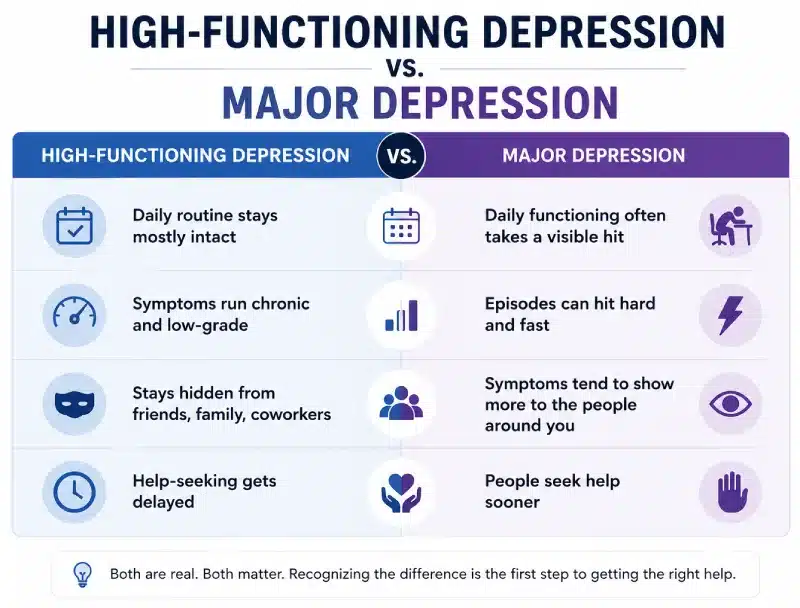
This comparison explains why so many people wait years to treat hidden depression. If your symptoms don’t match the version of depression you’ve seen in movies or heard about from others, it’s easy to convince yourself you don’t qualify for help.
What Causes High-Functioning Depression?
Depression rarely comes from one single cause. It usually builds from biological, psychological, and environmental factors stacking on top of each other over time.
Biological factors set the underlying vulnerability. Genetics play a measurable role, having a parent or sibling with depression raises your own risk, even if your symptoms look different from theirs. Differences in brain chemistry, particularly in how serotonin and dopamine regulate mood and motivation, also shape how intensely you experience stress and how quickly you recover from it.
Psychological factors shape how that vulnerability shows up. Perfectionism often develops as a survival strategy, if everything looks flawless, no one questions how you’re actually doing. Unresolved trauma and chronic stress that never gets processed, rather than talked through or treated, tends to resurface later as the emotional numbness and hopelessness described above. People who learned early on to push through discomfort instead of naming it out loud are especially prone to this pattern.
Environmental factors apply ongoing pressure on top of biological and psychological vulnerability. Demanding jobs, family expectations, financial stress, and isolation all make it harder to slow down long enough to notice what’s happening internally. High-pressure careers and caregiving roles are particularly common triggers, since both reward constant output and rarely leave space for rest.
Who’s Most at Risk?
Certain roles and life situations make high-functioning depression more likely to develop, largely because they reward pushing through rather than slowing down.
- Professionals in high-pressure or high-visibility careers where taking time off or admitting difficulty can feel like it threatens your reputation or advancement.
- Healthcare workers who are trained to prioritize patient needs above their own.
- Caregivers managing a spouse, child, or aging parents, with little time or permission to focus on their own wellbeing.
- Entrepreneurs who believe the business can’t function without them, even for a day.
- Students juggling academic performance and often a first experience of independent responsibility, all at once.
- Parents managing a household with little outside support.
- People with a family history of depression who carry a higher baseline biological risk.
- People already managing an anxiety disorder since anxiety and depression frequently co-occur.
If several of these describe you, it doesn’t automatically mean you’re depressed. It does mean your internal state deserves a closer look than you’ve probably been giving it.
When Does High-Functioning Depression Become Dangerous?
High-functioning depression can stay stable for a long time, but stability isn’t the same as safety. Watch for these signs that things are shifting into more serious territory:
- Symptoms worsening – When sadness, numbness, or fatigue that used to come and go now feels constant.
- Suicidal thoughts – Any thoughts of not wanting to be here or of harming yourself. These should never be dismissed because “things still look fine” on the surface.
- Emotional exhaustion – A depletion so deep that even rest or time away doesn’t restore you the way it used to.
- Burnout – When the coping mechanisms that used to work stop being enough.
- Substance misuse – Using alcohol or other substances to numb symptoms which frequently escalates alongside untreated depression.
- Relationship problems – Growing distance or conflict with people, often because emotional numbness leaves little left to give.
From Dr. Ash Bhatt’s Perspective:
The patients who worry me most aren’t the ones falling apart in front of everyone. They’re the ones still performing well right up until something breaks. If you’re having thoughts of suicide, call or text 988 right now. Don’t try to manage that alone.
If you’re having thoughts of suicide, call or text 988 (the Suicide & Crisis Lifeline) right now. This is not something to manage alone, and reaching out doesn’t mean you’ve failed at coping, it means you’re getting the support this actually requires.
Depression that goes untreated for years often overlaps with substance use. If that sounds familiar, our co-occurring disorders program treats both conditions together, since treating one without the other rarely holds.
How Is High-Functioning Depression Diagnosed?
A proper diagnosis takes more than a self-assessment quiz. Clinicians typically combine several tools to understand the full clinical picture.
- Clinical interview – A conversation covering your mood history, how long symptoms have lasted, and how they show up in your daily life, work, and relationships.
- DSM-5 criteria – Your symptoms get compared against the formal criteria for Persistent Depressive Disorder, major depressive disorder, or other mood disorders to identify the closest match.
- Screening tools – Standardized questionnaires like the PHQ-9 quantify symptom severity and give clinicians a baseline to track improvement over time.
- Medical evaluation – A physical exam and health history to check for other conditions that might be contributing to or mimicking depressive symptoms.
- Ruling out physical causes – Bloodwork checks for thyroid disorders, vitamin deficiencies (particularly vitamin D and B12), and medication side effects, all of which can produce symptoms that look identical to depression but require an entirely different treatment.
This process matters because getting the diagnosis right directly determines which treatment will actually help. Treating a thyroid disorder with antidepressants, for example, won’t resolve symptoms that are physiological in origin.
Treatment for High-Functioning Depression
Therapy
- Cognitive Behavioral Therapy (CBT) identifies and restructures the negative thought patterns that reinforce hopelessness and low self-worth.
- Dialectical Behavior Therapy (DBT) builds skills for regulating intense emotions and tolerating distress without turning to avoidance or self-criticism.
- Acceptance and Commitment Therapy (ACT) helps you build psychological flexibility, so difficult emotions don’t have to be eliminated before you can move forward.
- Trauma-informed therapy addresses past experiences directly when they’re feeding into current depressive symptoms.
Medication
- SSRIs (selective serotonin reuptake inhibitors) are typically the first medication tried, working by increasing serotonin availability in the brain.
- SNRIs (serotonin-norepinephrine reuptake inhibitors) target both serotonin and norepinephrine, often used when SSRIs alone aren’t sufficient.
- Other antidepressants, including atypical options, may be considered based on your specific symptom profile, side effect sensitivity, and treatment history.
All medication decisions should be made and monitored by a prescribing physician, since finding the right medication and dose often takes some adjustment.
Lifestyle Changes
- Exercise measurably increases endorphins and supports the same neurotransmitter systems targeted by antidepressant medication.
- Sleep regulation helps stabilize mood, since both too little and too much sleep are linked to worsening depressive symptoms.
- Nutrition affects energy levels and brain function directly, and deficiencies in key nutrients can worsen depressive symptoms independently.
- Mindfulness practices build the capacity to notice difficult emotions without immediately reacting to or suppressing them.
Comprehensive Treatment
Individual pieces of treatment work best combined rather than pursued in isolation. Comprehensive, individualized care accounts for the fact that high-functioning depression frequently overlaps with anxiety, burnout, or substance use, and addresses all of it under one coordinated plan rather than treating each piece separately. When symptoms start pulling you under despite everything you’re doing to hold it together, an inpatient depression rehab program gives you the structure and space to actually reset.
Can High-Functioning Depression Go Away?
Recovery is realistic, and early treatment consistently produces better outcomes than waiting until symptoms escalate. Since high-functioning depression often overlaps with PDD’s chronic nature, the goal is building sustainable, long-term management that keeps symptoms from controlling your life.
Recovery expectations: Many people notice measurable improvement within weeks to months of starting therapy, medication, or both. Full symptom relief can take longer, particularly for symptoms that have been present for years.
Early treatment shortens that timeline significantly. The longer depressive symptoms go unaddressed, the more entrenched the underlying thought patterns and coping habits become, which makes treatment take longer to work.
Long-term symptom management typically includes ongoing therapy check-ins, medication adjustments as your needs change, and continued attention to the lifestyle habits, that support mood stability over time.
Preventing relapse starts with learning your own early warning signs. Knowing what your personal pattern looks like before a full relapse, gives you and your treatment team a chance to intervene early rather than starting over from scratch.
How to Support Someone With High-Functioning Depression
If someone you love seems to have it all together but feels off underneath, here’s how to actually help:
- Listen without judgment – Let them talk without immediately offering solutions, minimizing what they’ve shared, or comparing it to your own experiences.
- Encourage evaluation – Gently suggest a professional evaluation rather than diagnosing them yourself or telling them what you think is “really” going on.
- Avoid minimizing feelings – Resist saying things like “but you’re doing so well”, since this reinforces the exact shame that keeps people from opening up.
- Stay connected – Keep reaching out consistently, even when they decline invitations or go quiet, since withdrawal is often a symptom.
- Know emergency warning signs -So you can act quickly if the situation escalates, rather than learning them for the first time in a moment of crisis.
Conclusion
If several of these patterns sound familiar, the next step isn’t to wait and see if they pass on their own. A licensed clinician can assess whether what you’re experiencing meets criteria for Persistent Depressive Disorder, major depressive disorder, or another condition, and build a treatment plan around your specific symptoms rather than a general label.
Legacy Healing offers individualized evaluation and treatment for depression, including options for people whose symptoms haven’t yet disrupted their daily functioning but are still affecting their quality of life. Reach out to our team to schedule an evaluation and find out what treatment could look like for you.