




-
 By:
Valerie Puffenberger, PMHNP-BC
By:
Valerie Puffenberger, PMHNP-BC -
Editor:
Phyllis Rodriguez, PMHNP-BC
-
Clinical Reviewer:
Dr. Ash Bhatt, MD, MRO
 By:
By:
 Editor:
 Clinical Reviewer:
If you are asking how long does Xanax withdrawal last, or what the Xanax withdrawal timeline looks like day by day, you are asking the right questions. The answers matter clinically, not just for your own understanding but because how Xanax withdrawal is managed determines whether the process is dangerous or safe, unbearable or navigable.
For people with significant physical dependence, the benzo withdrawal timeline carries genuine medical risks, including seizures, severe cardiovascular instability, and psychological crisis. These risks are not hypothetical. They are documented and they are preventable with the right clinical support.
This guide walks through the xanax withdrawal symptoms timeline day by day, explains the underlying neuroscience, and describes what professional Xanax detox treatment looks like for individuals ready to begin xanax recovery at Legacy Healing Center.
Key Takeaways1. The Xanax withdrawal timeline begins within 6–12 hours of the last dose and peaks in Days 2–4. Acute benzo withdrawal timeline symptoms typically resolve over 1–2 weeks; post acute withdrawal syndrome Xanax (PAWS benzodiazepine symptoms) can persist for weeks to months. 2. Xanax withdrawal is medically serious. Seizure risk Xanax withdrawal is real and documented. The dangers of stopping Xanax suddenly, cold turkey, include grand mal seizures and potentially fatal complications. Medical supervision is not optional for significant alprazolam dependence. 3. Supervised tapering and professional Xanax detox treatment transforms the withdrawal experience. A properly designed clinical protocol eliminates the most dangerous risks, reduces symptom severity, and creates the foundation for long term recovery benzodiazepines alongside evidence-based treatment of the underlying conditions. |
What Is Xanax Withdrawal?
Xanax is the brand name for alprazolam, a benzodiazepine prescribed for anxiety disorders and panic disorder. Alprazolam withdrawal occurs when a person who has developed physical xanax dependence reduces their dose significantly or stops taking it. Because Xanax is a short-acting benzodiazepine, with a half-life of approximately 11 hours, its central nervous system effects disappear quickly, and the consequences of its absence appear fast.
To understand benzodiazepine withdrawal fully, it helps to understand what Xanax does in the brain. Alprazolam works by enhancing gamma-aminobutyric acid (GABA), the brain’s primary inhibitory neurotransmitter, producing the calm, and sedative central nervous system effects that make it effective. With regular use, the brain adapts by reducing its own GABA activity and increasing the sensitivity of excitatory receptors. When the drug is removed, the calming influence disappears and the nervous system becomes hyperactive.
Xanax dependence can develop within weeks of regular use, faster than most people expect, and sometimes even at prescribed therapeutic doses. The short half-life also means that some individuals begin to experience mild alprazolam withdrawal between doses, which can be mistaken for the return of anxiety and inadvertently drives dose escalation.
Key clinical facts about Xanax withdrawal:
|
Day-by-Day Xanax Withdrawal Timeline
The xanax withdrawal symptoms timeline below represents the typical clinical progression for someone with moderate to significant Xanax dependence. Individual experiences vary based on dose, duration of use, and individual factors. This framework describes what to expect, not a rigid guarantee of exactly when each symptom will appear.
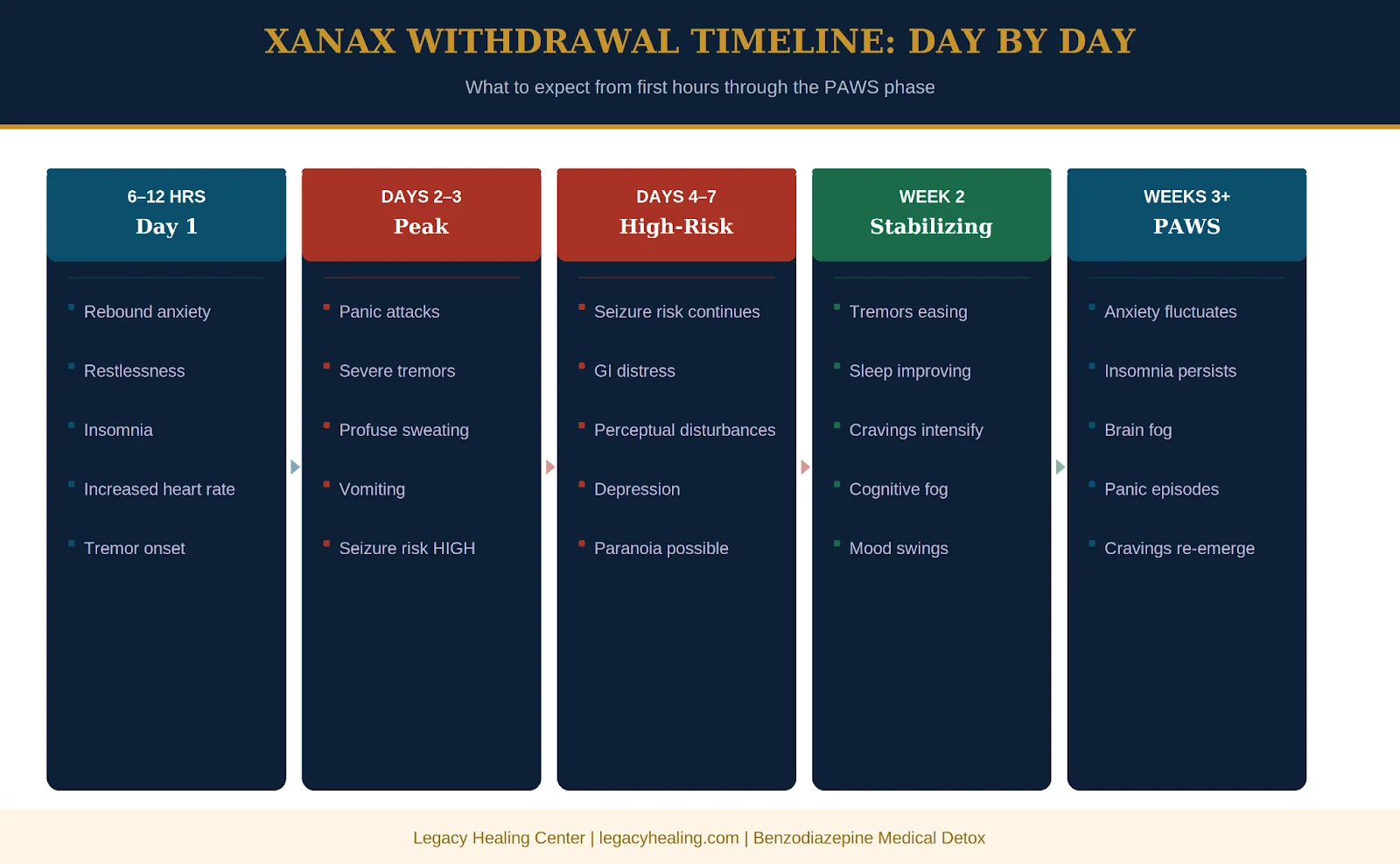
Day 1 (6–12 Hours After Last Dose)
Day 1 Xanax withdrawal begins faster than most people anticipate. Because alprazolam’s half-life is only around 11 hours, early withdrawal symptoms Xanax presents well before a full day has passed.
The rebound anxiety benzo effect in these first hours is an important clinical distinction. What a person feels is a pharmacological amplification of anxiety caused by the nervous system’s overreaction to the sudden loss of GABA enhancement. This is often the mechanism that drives people to reinstate the medication within hours, making the medical supervision from the first hours of withdrawal essential.
Day 16–12 hrs post-dose |
|
Day 2–3 (Peak Symptoms)
Days 2 and 3 represent peak Xanax withdrawal symptoms for most people. The central nervous system is now in full excitatory rebound, the acute benzodiazepine withdrawal phase at its most intense. Day 3 Xanax withdrawal is often the highest-severity point in the acute phase when medical oversight is most critical.
Panic attacks during this phase are neurologically generated and a direct consequence of the unchecked excitatory nervous system activity in acute benzodiazepine withdrawal.
Days 2–3Peak intensity |
|
Day 4–7 (High-Risk Phase)
Days 4 through 7 remain the dangerous withdrawal phase of Xanax withdrawal. Physical symptoms may begin to ease slightly from their Days 2–3 peak, but the seizure risk Xanax withdrawal carries remains elevated, and benzo withdrawal risks continue. The range of severity in this phase is broad, determined largely by dose and duration of prior use.
Days 4–7High-risk phase |
|
Week 2 (Stabilization Phase)
Xanax withdrawal week 2 typically marks the beginning of physiological stabilization. The acute physical dangers of the first week begin to recede. The benzo withdrawal recovery timeline enters a phase where tremors, sweating, and cardiovascular instability ease, though the experience remains far from resolved.
Withdrawal duration Xanax in the second week varies significantly based on individual factors. For some, this week brings genuine turning-point relief. For others, particularly those with high-dose histories, lingering withdrawal symptoms in week two can be as disabling psychologically as the earlier physical phase was physically.
Week 2Stabilization |
|
Weeks 3+ (Post-Acute Withdrawal – PAWS)
Post acute withdrawal syndrome Xanax, PAWS benzodiazepine syndrome, describes the extended phase of psychological and neurological symptoms that can persist for weeks to months after acute physical withdrawal has resolved.
Long term withdrawal symptoms in the PAWS phase do not mean recovery is failing. They reflect the time the brain requires to recalibrate GABA and excitatory systems that were pharmacologically managed for months or years. The benzo PAWS timeline is individual, research indicates protracted symptoms can fluctuate for up to six to twelve months in some cases, typically diminishing in frequency and intensity with appropriate therapeutic support.
Weeks 3+PAWS phase |
|
Factors That Affect the Xanax Withdrawal Timeline
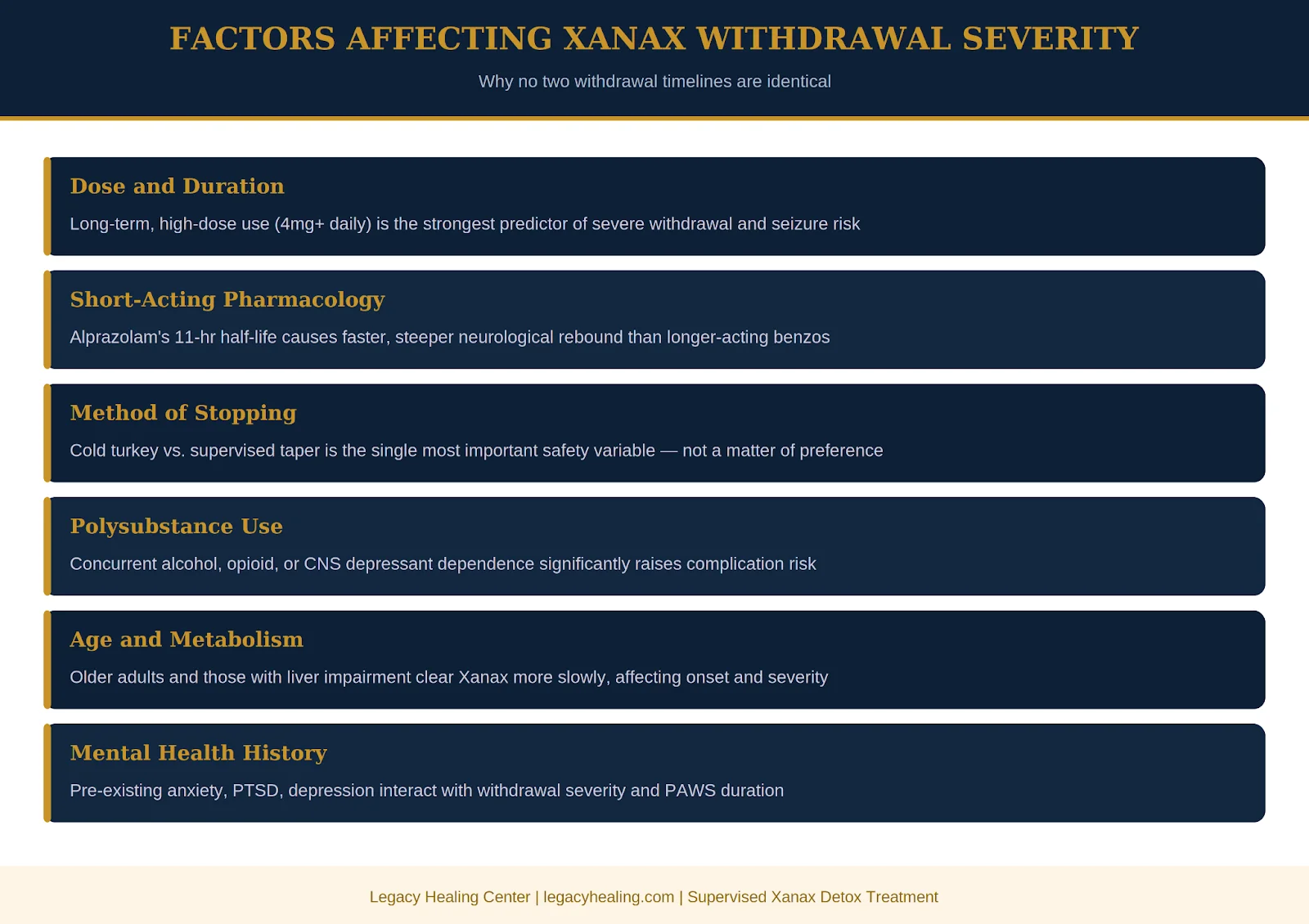
No two xanax withdrawal symptoms timelines are identical. Factors affecting Xanax withdrawal are numerous and interact in clinically important ways. Understanding them helps set realistic expectations and determines the level of medical supervision that is appropriate.
Full List of Xanax Withdrawal Symptoms
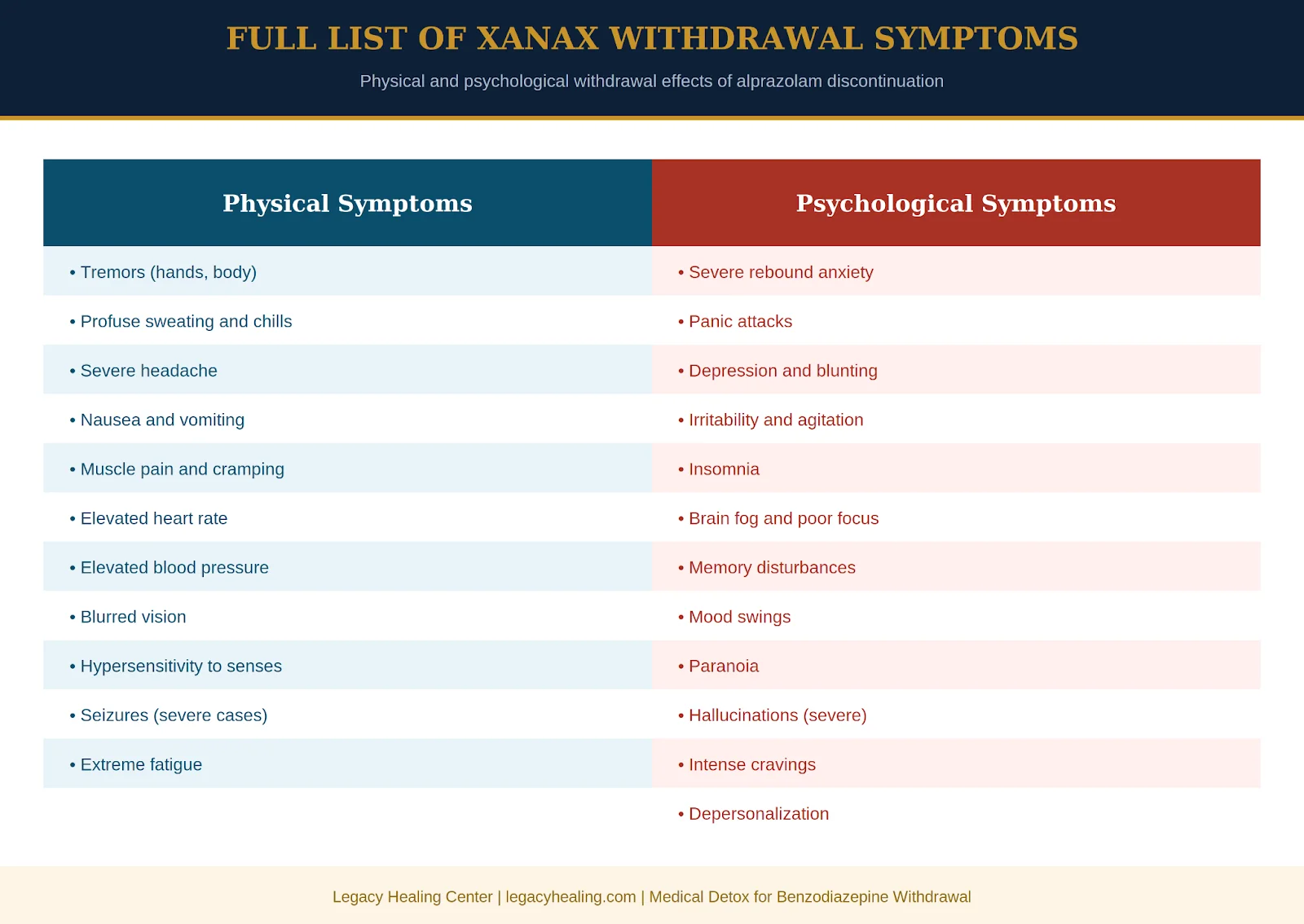
The following xanax withdrawal symptoms list covers the full range of physical withdrawal symptoms and psychological withdrawal effects associated with alprazolam discontinuation. Individual presentation depends on dose, duration, and the individual factors described above.
Why Xanax Withdrawal Is More Intense Than Other Benzos
Is Xanax withdrawal dangerous compared to other benzodiazepines? Clinically, yes, and the reason is pharmacological. Alprazolam short acting risks arise directly from the speed at which the drug leaves the body. Withdrawal severity Xanax is consistently higher than that of longer-acting benzodiazepines, and benzo withdrawal intensity is amplified by several mechanisms specific to alprazolam.
First, the half-life of approximately 11 hours means blood levels fall faster and more steeply than with drugs like diazepam (Valium, 20–100 hour half-life) or chlordiazepoxide (Librium). The neurological rebound is sharper because the decline in GABA enhancement is more abrupt.
Second, alprazolam has high binding affinity for GABA-A receptors, the brain adapts to its presence significantly.
Third, alprazolam withdrawal has been associated with higher rates of rebound anxiety than other benzodiazepines, a specific pharmacological characteristic that makes the psychological dimension of withdrawal particularly intense.
For these reasons, many medical detox benzodiazepines protocols do not taper alprazolam directly. Instead, they transition patients to a longer-acting benzodiazepine such as diazepam, providing more stable blood levels before beginning dose reduction.
“Xanax’s short half-life is the same feature that makes it fast-acting for anxiety and medically serious to discontinue. Those two facts are not coincidental, they are the same pharmacology, producing opposite consequences at the beginning and end of treatment.”
Safe Detox: How Professional Treatment Works
Xanax detox treatment at a professional level fundamentally changes the trajectory of withdrawal. Medical detox benzodiazepines protocols at our treatment Center combine supervised tapering Xanax with pharmacological symptom management and continuous clinical oversight, creating the physiological conditions for safe recovery.
- Supervised tapering Xanax. A gradual, physician-designed dose reduction protocol, typically 10–25% every one to four weeks depending on individual response, prevents the abrupt neurological rebound that makes unsupervised stopping so dangerous.
- Cross-taper to longer-acting benzodiazepine. Many patients transition from alprazolam to diazepam before tapering begins, providing more stable blood levels and a pharmacologically smoother withdrawal curve.
- Anticonvulsant medication. Gabapentin, valproate, or other agents reduce seizure risk and manage neurological excitability during the high-risk phase.
- Symptomatic management. Sleep, blood pressure, nausea, and anxiety are managed with appropriate medications throughout the acute phase.
- 24/7 clinical monitoring. Continuous vital sign monitoring and clinical assessment allow immediate response to any deterioration.
- Psychological support from day one. Therapy and clinical counseling begin during detox, not after it, addressing the psychological dimensions of withdrawal alongside the physical.
How to Manage Xanax Withdrawal Symptoms Safely
How to ease Xanax withdrawal most effectively is answered with a single clinical truth: the most powerful symptom management is a properly designed tapering benzodiazepines protocol under medical supervision. Withdrawal symptom management without a structured taper treats consequences. A supervised taper addresses the underlying cause.
Within a medically supervised program, these strategies support detox support and reduce the daily burden of withdrawal:
- Gradual dose reduction: The cornerstone of safe Xanax management. Tapering benzodiazepines safely means reducing by 10% every two to four weeks for high-risk cases, slower is better.
- Sleep support: Structured sleep hygiene protocols plus melatonin and, where appropriate, low-dose antidepressants, because insomnia is one of the most persistent and destabilizing Xanax withdrawal symptoms.
- Nutritional restoration: Hydration, nutrition, and magnesium and B-vitamin supplementation support the neurological repair that withdrawal requires.
- Mindfulness and breathing techniques: Evidence-based anxiety management that helps patients navigate rebound anxiety and panic without reinstating medication.
- Physical activity: Where medically appropriate, gentle movement reduces muscle tension, anxiety, and restlessness, and supports sleep quality.
- Avoiding alcohol: Critical. Cross-tolerance between benzodiazepines and alcohol means alcohol use during withdrawal significantly complicates the clinical picture and elevates seizure risk.
Why You Should Not Quit Xanax Cold Turkey
Quitting Xanax cold turkey is one of the most medically dangerous forms of drug discontinuation in modern medicine. The dangers of stopping Xanax suddenly are not cautionary exaggerations, they are documented clinical outcomes that include death.
Benzo withdrawal risks of cold turkey cessation include:
- Grand mal seizures: highest risk in the first 72 hours, persisting through day 7
- Status epilepticus: a life-threatening prolonged seizure state
- Severe cardiovascular instability: dangerously elevated blood pressure and heart rate
- Psychotic episodes: hallucinations, paranoia, complete disconnection from reality
- Delirium: comparable in severity to severe alcohol withdrawal delirium tremens
- Extreme suicidal ideation generated by neurological distress, not pre-existing psychology
The safe taper vs cold turkey distinction is a difference in survival risk. A properly designed supervised taper with appropriate anticonvulsant coverage eliminates the vast majority of these dangers. Cold turkey creates them unnecessarily.
⚠ Never quit Xanax cold turkey – it is a medical emergency in waitingQuitting Xanax cold turkey without medical supervision carries real risk of seizure and death. The seizure risk is highest in the first 72 hours but persists for the full first week. Symptoms can appear to improve and then worsen suddenly. creating dangerous false confidence. If someone has stopped Xanax abruptly and is experiencing tremors, confusion, or any seizure activity: call 911 immediately. |
Hidden Withdrawal in High-Functioning Individuals
High functioning Xanax addiction is one of the most underrecognized presentations in addiction medicine. Executive substance use and high-level professional Xanax dependence frequently develop entirely within the structure of a successful, high-achieving life, making them uniquely difficult to identify, for both the person affected and those around them.
Professional burnout addiction and Xanax dependence in high-functioning individuals typically present through subtle behavioral patterns:
- Escalating dose without prescription review: the therapeutic dose is no longer sufficient
- Experiencing anxiety or irritability between doses: interpreted as the condition worsening
- Building daily schedules around medication timing: subtle but significant behavioral reorganization
- Finding professional or social situations unmanageable without prior Xanax use
- Carefully managing prescription access: tracking quantities, timing refills, identifying compliant providers
- Experiencing withdrawal-like symptoms during travel or weekends when routine access is disrupted
Our confidential rehab programs are specifically designed to serve this population, providing clinical excellence within an environment that protects what matters to the people who need treatment most.
| “The most dangerous myth about Xanax addiction is that it only affects people who are visibly struggling. High functioning addiction is real, it is common, and it is no less medically serious for being invisible.” |
From Detox to Full Recovery
Xanax addiction treatment does not end at detox. Detox addresses the physical dependency, the neurological recalibration that allows the body to function without alprazolam. What happens afterward determines whether that recalibration holds.
Long term recovery benzodiazepines requires treating what drove the Xanax use in the first place. For most people with Xanax dependence, that underlying condition is anxiety, real, often severe, and requiring treatment in its own right. It does not disappear because the medication has been removed. It requires evidence-based psychotherapy, sustainable anxiety management skills, and in many cases appropriate alternative pharmacological support.
Evidence-Based Therapies for Long-Term Xanax Recovery
- Cognitive Behavioral Therapy (CBT). The most extensively evidenced psychotherapy for anxiety disorders, the primary condition requiring treatment for most people following Xanax detox. CBT provides practical, durable tools for managing anxiety without chemical suppression.
- Dialectical Behavior Therapy (DBT). Addresses emotional dysregulation. the difficulty tolerating distress, uncertainty, and uncomfortable internal states, that underlies many forms of benzodiazepine dependence.
- Dual diagnosis treatment. Co-occurring anxiety disorders, depression, PTSD, and panic disorder must be treated concurrently with the addiction. Dual diagnosis treatment that addresses the whole clinical picture produces substantially better relapse prevention outcomes.
- Relapse prevention. Understanding personal triggers, building coping strategies, and recognizing the early signals of PAWS-phase vulnerability before they translate into relapse requires explicit skills development in treatment and sustained support in aftercare.
Take the First Step Toward Recovery
If you are managing Xanax withdrawal, navigating a dependence you are not sure how to stop safely, or supporting someone close to you through this, private Xanax detox with expert clinical support is available, and immediate detox admission is possible.
We offer confidential rehab programs designed for individuals who require both clinical excellence and genuine privacy. Our luxury addiction treatment environment provides the medical infrastructure of serious addiction medicine within a residential setting that protects the professional and personal circumstances of the people in our care.
Contact our admissions team today for a confidential assessment and insurance verification. There is no cost to that conversation. Immediate detox admission is available for those who are ready.
“Every day of Xanax withdrawal safely managed under expert clinical supervision is a day the brain is reclaiming itself. The process is difficult. The destination is worth it.”