




-
 By:
Alex Herrera
By:
Alex Herrera -
Editor:
Phyllis Rodriguez, PMHNP-BC
-
Clinical Reviewer:
Dr. Ash Bhatt, MD, MRO
 By:
By:
 Editor:
 Clinical Reviewer:
Begin Healing and Moving Forward
“You are not what happened to you. You are what you choose to become.”
— Carl Jung
This is for anyone and everyone—we are so grateful you are here.
We all carry something.
For some, it’s the weight of addiction. For others, it’s the heartbreak of loving someone who’s struggling. Some carry the emotional pain of difficult experiences that trigger negative emotions, such as regret, unresolved anger, trauma, or grief of past mistakes, so deep it feels impossible to name, let alone release.
Whatever you’re holding, know this:
You are not broken beyond repair. You are not alone. And no matter where you are right now, healing is still possible.
At Legacy Healing Center, we’ve walked beside people who believed they had reached the end. And yet, time and time again, we’ve witnessed their personal growth and new beginnings — because when the healing process starts, the impossible becomes possible.
Maybe you’re at that threshold now in this present moment. Standing still. Unsure. Exhausted.
This is your reminder:
There is a way forward.
The Emotional Weight of the Past

The past can feel heavy and inescapable.
Maybe it’s the years lost to addiction, a blur of days you can’t remember and moments you wish you could forget. Maybe it’s broken relationships that fractured under the weight of survival.
For many, the painful feelings go deeper, into a childhood marked by instability, abuse, or neglect. Wounds inflicted by people who should have provided a safe space and protected you. Past experiences that never fully healed and still ache in your daily life in the quiet, lonely hours. Some carry grief that was never spoken, guilt that feels too big to face, or shame that burrows so deep it becomes part of their identity.
We adapt in the only ways we know how—numbing ourselves with substances, distraction, perfectionism, control, isolation—to survive. We cling to toxic relationships out of fear of being alone. We build walls, wear masks, and live on autopilot because it feels safer than being fully seen. And after enough time, those survival tools start whispering cruel lies:
You’re too damaged. You’re too far gone. You’ll never change. Healing isn’t for people like you.
But here is the truth: those are just painful stories, trauma narratives — not permanent truths. They were born from trauma, not truth. They kept you alive, but they are not meant to define you.
You are not your mistakes. You are not your addictions. You are not your past.
You are a human being who has lived through negative experiences — and who, despite it all, is still here. Reading this. Hoping for more. That hope alone means the door is not closed.
Reflection:
What am I still carrying that no longer serves me?

The Turning Point: When Something Inside You Whispers “More”
There often comes a moment–sometimes loud and undeniable, other times just a quiet ache in the chest–when something deep inside begins to stir. A flicker of light that breaks through the darkness, almost too faint to believe in. A whisper that says:
This can’t be it. I was made for more than this pain.
It may feel terrifying to let go, not because the pain is unbearable, but because it’s what we’ve known.
Pain can become identity. Chaos becomes comfort. Numbing becomes normal. Even suffering can feel like a kind of comfort when it’s all we’ve known.
Healing, by contrast, feels foreign. Unsteady. Vulnerable.
Taking actionable steps towards acceptance means releasing what’s familiar, even if that familiarity is built from brokenness. It means letting go of the negative thoughts and narratives we’ve clung to, even the ones that hurt us, because they made sense of the pain.
It’s easier, sometimes, to stay where we are than to step into the unknown, because letting go means more than just putting the past behind us.
Letting go is the first step towards a fulfilling life, but it means reflecting and stepping into the unknown.
- Not to relive the past events, but to understand it and avoid repeating it
- Not to erase the painful feelings, but to stop letting it define your present and future
Letting go doesn’t mean we forget. It doesn’t mean the scars vanish or the grief disappears.
It means we stop dragging the same chains forward.
It’s choosing freedom over familiarity. Growth over comfort. Peace over punishment.
Try Saying It Yourself:
“I am allowed to move on. I am allowed to heal. I am allowed to become.”
What Does It Really Mean to Let Go of the Past?

Letting go doesn’t mean pretending it didn’t happen.
t doesn’t mean sugarcoating the past events, excusing the people who hurt you, or skipping over the real grief you’ve carried. It doesn’t mean the pain disappears overnight. Healing doesn’t ask you to erase what you’ve been through, only to stop letting it define who you are. It means acknowledging the past without letting it write your future.
Letting go means:
- Reclaiming your power, even when it feels shaky.
It’s saying, I may not have had control over what happened to me, but I do have a say in who I become next. Even if it’s just one small, brave decision at a time. Self-care begins with your own life and the commitment to be accountable for the course of it. - Speaking to yourself with kindness.Not because you think you’ve earned it, but because you need it.
Because the way you speak to yourself shapes your healing.
Acknowledging you make mistakes and honoring past experiences reinforces the simple truth that you are human. You are not weak for struggling with challenging memories, but you are worthy of self-compassion, especially from yourself. - Making peace with who you were.That version of you did what they needed to do to survive.
You don’t have to hate them — you can honor the relationship you had with that part of yourself.
They were doing their best with what they knew.
Now, you can learn lessons from what they carried, thank them for getting you this far, and gently let them rest. - Give yourself mercy.
Not because what happened didn’t matter, but because punishing yourself forever won’t change it.
Forgiveness is not forgetting — it’s recognizing that there’s no benefit in carrying endless shame.
It’s the courageous act of saying: I won’t keep hurting myself for who I used to be.
Forgiveness allows you to reclaim your ability to grow, to heal, and to show up differently in the world.
You begin to realize that your past does not limit your future — it simply shaped the path that brought you here. - Giving yourself permission to become someone new.
Not because the old you was unlovable, but because growth begins with acceptance of who you were, what you’ve been through, and who you’re becoming.
There’s no benefit in clinging to old patterns shaped by anger.
You are allowed to embrace change, to prioritize your mental health, and to believe in something better. You are allowed to dream again, to hope again, to rebuild.
Even if you are still in pieces. Even if you are scared — especially then.
And as you step forward, you begin creating new memories rooted in healing, not survival.
Letting go is a daily choice, sometimes moment by moment. And that choice—no matter how small—is always yours to make and will make a lasting impact when you do.
You are not what happened to you. You are what you choose next.
How to Move Forward When You’re Stuck in the Past
Moving forward doesn’t necessarily mean a giant leap.
More often, it’s a quiet, trembling step in the direction of something better, even if we don’t know exactly what that “better” looks like yet.
Sometimes, it feels like two steps forward, one step back; it feels like crawling; it feels like nothing is changing at all…until one day, you look back and realize you have made it through things that once felt impossible. Part of learning how to let go of the past is accepting that healing doesn’t happen all at once.
Healing doesn’t ask you to have it all figured out. It just asks you to begin.
Moving forward might mean:
- Waking up and choosing not to pick up the drink, the drug, the call from a dealer, a destructive friendship, or a toxic relationship, even if the craving is still screaming. It’s recognizing that healing is a process, not a one-time decision.
- Reaching out, even when every part of you wants to shut down, because connection is essential for mental health and overall well-being.
- Sitting with difficult emotions instead of numbing them. A courageous act that requires vulnerability and the willingness to practice mindfulness.
- Saying no to chaos and yes to healing, even when change feels unfamiliar and challenging.
- Crying in your car before your first support group meeting, during a call with your sponsor, or after a therapy session – and still showing up again, for YOURSELF, tomorrow, and the next day, and the next week, and the next month.
- It means forgiving yourself for what you didn’t know, and trusting that you’re becoming the person you were always meant to be.
- It’s choosing to let the past be part of your story, not the whole story. You can honor your memories while gently releasing their grip.
- It’s realizing that while you can’t change the past, you do have control over where you place your focus: on the present, on healing, and on what’s possible in your world now.
And when the emotions feel too heavy, it means knowing it’s okay to seek professional help, because you were never meant to do this alone.
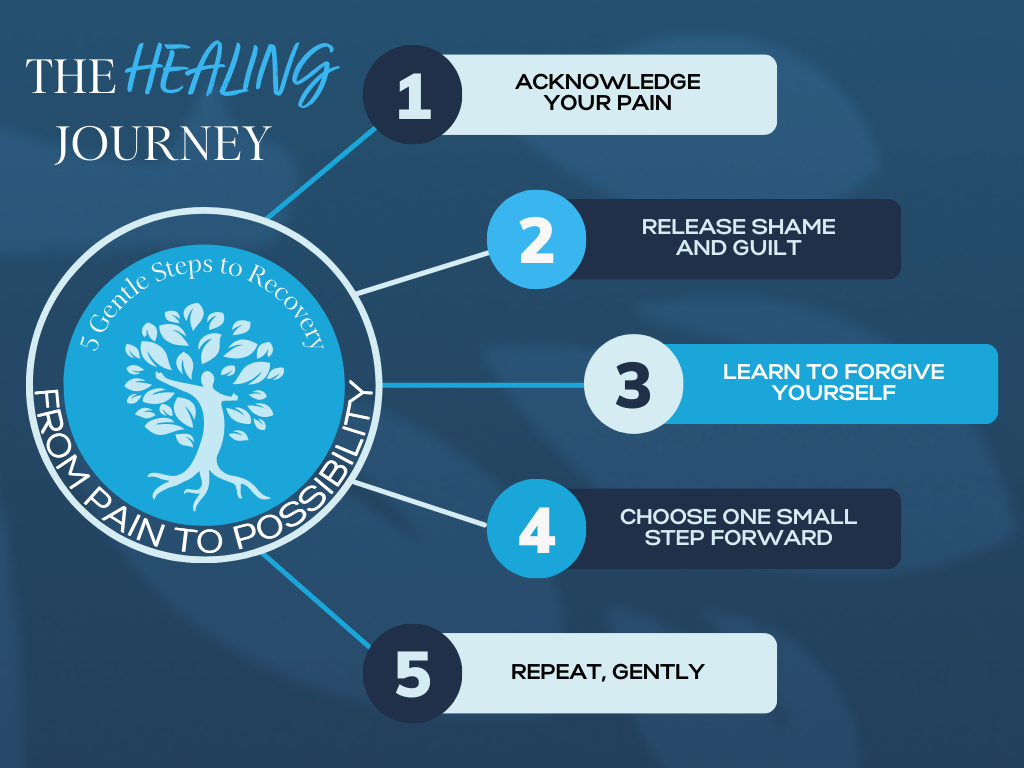
A Note on Forgiveness for Yourself
A Note on Forgiveness for Yourself
Forgiving yourself isn’t a one-time decision — it’s a process that unfolds gently, often in the quiet moments when you’re learning to sit with your emotions, especially the difficult ones like anger, grief, and emotional pain.
It’s not about saying, “I did nothing wrong.” It’s saying:
“I see what happened. I see how I hurt myself or others, and I choose to no longer live in shame.”
True forgiveness begins with self-compassion — the understanding that you did what you could with the tools and awareness you had at the time. The version of you who made those choices was trying to survive. Forgiveness honors that truth without letting it define your future.
It’s choosing to embrace change, even when it’s challenging. It’s learning how to hold both memories and hope in the same breath — to say, Yes, this happened, but I am not only what happened to me.
It’s learning to practice mindfulness in the moments when the past creeps in — pausing to breathe, focus on your thoughts without judgment, and return to the present, where healing actually happens.
Sometimes forgiveness means seeking out a mental health professional or engaging in commitment therapy to help unravel the beliefs that have kept you stuck. It can also mean creating a safe space with a trusted friend, healed person, or healthy relationship, where your story can be heard without fear.
Forgiveness is a form of self-care — a way to stop self-punishment and start showing up with kindness for the person you are becoming. It’s allowing yourself to rest, to move your body through physical activity, and to seek support rather than isolate.
Most importantly, forgiving yourself is not about perfection. It’s about reclaiming control of your life, one small, loving choice at a time — a whispered reminder that you are not beyond healing.
You are still becoming.
You don’t have to be fearless. You just have to be willing.
Reflection
What does “one small brave step” look like for me today?
You Are Not Alone: Finding a Safe Place to Land
There is something deeply human in wanting to be seen. To have someone look at all the parts of your story — the beautiful, the broken, the painful, the proud — and say:
You are still worthy. You still matter. You are still lovable.
That is what we believe at Legacy Healing Center.
We are not just a treatment center. We are a place of restoration. A place where you can exhale the weight you have been carrying for far too long and be met with:
- Compassion, not judgment
- Dignity, not discomfort
- Belonging, not isolation
For those in the middle of recovery, at the very beginning, or still unsure if they are ready, you are welcome here. For those trying to survive, trying to hold it all together, trying not to fall apart, we want you to know:
You don’t have to try so hard anymore.
You don’t have to carry it all alone.
Whether you are someone struggling with addiction, someone loving an addict, or someone silently battling pain, we see you.
There is space here for your story. Space for your grief, your hope, your questions, your mess, your miracles. And we will hold it with you. We will walk with you, not ahead of you, not behind you — but with you.
At Legacy, healing is not a finish line. It’s a daily practice of coming home to yourself. It’s forgiving yourself and reclaiming a life that is still worth living. It’s discovering that your story isn’t over; in fact, a new chapter is waiting to begin.
And we are here when you are ready. With open arms and open hearts.Through trauma-informed therapy, compassionate rehab care, and tools to rebuild self-worth, Legacy Healing Center supports you in creating a life where grace becomes part of your story.
You don’t have to carry the weight of your past forever. Reach out—let’s begin healing together.
Grounding Exercise:
Close your eyes.
Breathe in deeply. Hold. Exhale slowly.Picture yourself standing at the shoreline of your life.
The past is behind you — not gone, but no longer pulling you under.
Ahead is possibility — not perfection, but peace.
Inhale: I am allowed to begin again.
Exhale: I release what no longer serves me.
That breath? That’s your beginning.
A Message of Hope
If you take nothing else, let it be this:
You are not too far gone. You are not beyond redemption. You are not defined by your addiction, trauma, or past.
Frequently asked questions about letting go | FAQS
How do you mentally let go of the past?
Mentally letting go of the past begins with recognition and self-compassion. It does not mean forgetting or excusing what happened, but rather choosing not to let it define who you are today. According to the article, it involves:
Reclaiming your power: Acknowledging that you can’t change what happened, but you can choose who you become.
Practicing kindness toward yourself: Speaking to yourself as you would to someone you love. You don’t need to earn compassion—you deserve it as a human being.
Accepting and understanding: Making peace with the version of yourself that survived, and recognizing that their choices came from pain, not from who you truly are.
Committing to daily healing: Letting go is not a one-time act but a continuous choice—often one small brave decision at a time.
It is a process of unlearning trauma narratives and rewriting your story with truth, grace, and hope.
What is it called when a person can’t let go of the past?
This difficulty is often referred to as rumination or emotional entanglement with trauma. While not always clinical, it can be tied to:
Post-Traumatic Stress Disorder (PTSD) when linked to specific traumatic experiences.
Complicated grief or shame cycles in the aftermath of addiction, loss, or abuse.
Survival mechanisms: The article points out that behaviors such as numbing, perfectionism, or isolation develop to cope with pain and are difficult to release because they feel familiar or protective.
In short, not letting go is not a flaw—it’s a symptom of surviving hard things. But as the article explains, “those are just painful stories, trauma narratives — not permanent truths.”
Why do I have a hard time letting go of the past?
There are several emotional and psychological reasons why letting go is difficult:
Suffering becomes part of your identity: Suffering and chaos may become “comfortable” simply because they are familiar.
Fear of the unknown: Healing feels vulnerable; even when the past was painful, it was predictable.
Unprocessed trauma: If early life was marked by instability or harm, the mind clings to old narratives to make sense of it.
Self-punishment: Guilt and shame often create a false belief that we deserve to carry the suffering forever.
As the article reminds us, healing isn’t about forgetting. It’s about releasing the chains of past narratives so they don’t shape our future.
How do I let go of past hurts?
Letting go of past hurts involves several gentle but intentional practices:
Acknowledge your pain without minimizing it. Healing starts with naming the wound.
Granting yourself forgiveness, not because the past doesn’t matter, but because punishing yourself forever won’t change it.
Create new narratives: Shift from “I am broken” to “I am healing.” Language shapes identity.
Engage in daily practices that support healing:
Therapy or support groups
Self-reflection and grounding exercises
Saying “no” to chaos and “yes” to stillness
Showing up for yourself, even when you are still processing the negative emotions
The article says: “Letting go is the first step toward freedom… It means to stop trying to control the past, and to focus your present growth on peace over punishment.”