


-
 By:
Valerie Puffenberger, PMHNP-BC
By:
Valerie Puffenberger, PMHNP-BC -
Editor:
Phyllis Rodriguez, PMHNP-BC
-
Clinical Reviewer:
Dr. Ash Bhatt, MD, MRO
 By:
By:
 Editor:
 Clinical Reviewer:
Key Takeaways
- A pill stamped “M30” proves nothing. The DEA has documented authentic and counterfeit oxycodone tablets that are visually identical, and its lab testing found that 29% of pills seized with fentanyl present contained a potentially lethal dose.
- CDC hospital data on suspected counterfeit M-30 exposures found that 81% of patients required hospitalization and 69% of those needed intensive care, and additional, undisclosed substances turned up in 9 out of 10 cases.
- Taking one counterfeit pill unknowingly is a safety event, not an addiction. The line gets crossed when someone keeps seeking pills despite knowing the risk.
A pill can look exactly like Percocet without containing a single trace of it. That single fact drives everything else in this article, and it’s the reason counterfeit pills have become one of the more dangerous problems in today’s illicit drug supply.
In this article, we’ll cover what fake Percocet pills actually are, how counterfeit M30s differ from a legitimate prescription, why appearance can’t tell you what’s inside a pill, and what it means when repeated use turns into something that needs professional treatment. We’ll also walk through what to do if a fake pill may have already been taken.
There are two dangers here, and they’re not the same. One is immediate: an unexpected substance or potency can cause overdose without warning. The other builds over time: repeated opioid exposure, whether from counterfeit pills or not, can lead to tolerance, cravings, and dependence.
What Are Fake Percocet Pills?
Fake Percocet pills are counterfeit tablets manufactured outside the pharmaceutical supply chain and pressed to resemble legitimate Percocet or oxycodone. They can contain fentanyl, other opioids, filler substances, or combinations the person taking them never agreed to.
Legitimate Percocet combines oxycodone with acetaminophen, and FDA-approved labeling has historically covered strengths such as 2.5/325 mg, 5/325 mg, 7.5/325 mg, and 10/325 mg, produced under regulated manufacturing standards that control dosage and consistency. Counterfeit pills have none of that oversight, since illicit manufacturers use pill presses and dyes to mimic a real product’s color, shape, and imprint.
The DEA’s One Pill Can Kill campaign reports that the agency seized more than 47 million counterfeit pills in 2025 alone, along with nearly 10,000 pounds of fentanyl powder, a combined haul the agency calculates as equivalent to more than 369 million lethal doses. That figure matters because it shows this isn’t a fading concern from a few years ago. It’s an active, growing part of the illicit drug supply right now.
The real question isn’t whether a pill “looks like Percocet.” It’s whether that pill passed through a licensed pharmacy, because that’s the only thing that actually confirms what’s inside it.
What Do Real Percocet Pills Look Like?
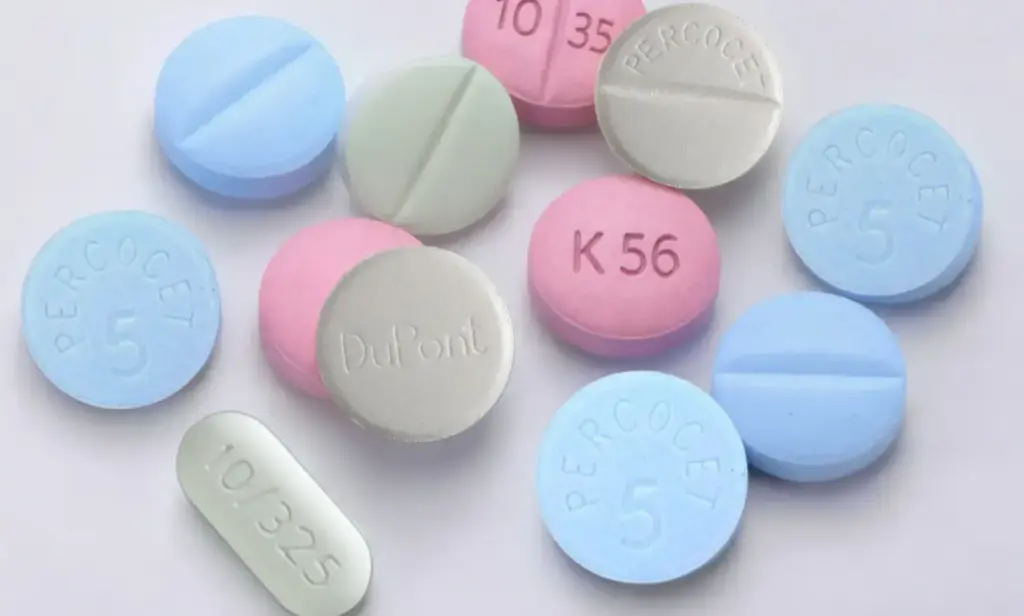
Legitimate Percocet tablets vary in color, shape, and imprint depending on strength and manufacturer, and that variation can offer useful information about a pill someone knows came from a pharmacy. What it can’t do is prove that an unfamiliar pill is authentic, because counterfeit manufacturers deliberately reproduce those same visual details.
Searches like “real Percocet 10,” “real Percocet 30,” and “blue Percocet pill” usually reflect someone trying to confirm a pill is genuine. That instinct makes sense, but a visual match against an online photo isn’t a safety test, since making a counterfeit look convincing is the entire point of the counterfeit process.
What does “real Percocet 30” actually mean?
This terminology creates an important source of confusion.
In the U.S., people may use phrases such as “Perc 30” or “Percocet 30” to refer to a 30-mg oxycodone tablet. However, Percocet and oxycodone are not interchangeable names for the same formulation.
Percocet is oxycodone combined with acetaminophen. A tablet commonly described as an M30 or “30” generally refers to a 30-mg oxycodone tablet rather than a standard Percocet combination tablet.
So someone searching for a “real Percocet 30” may actually be looking for information about a 30-mg oxycodone tablet.
That distinction becomes especially important when discussing counterfeit M30 pills.
Is an M30 Pill the Same as Percocet?
No, and this is one of the most important distinctions in the entire topic. “M30” refers to a 30 mg oxycodone tablet, a single-ingredient medication, while Percocet always combines oxycodone with acetaminophen. People use “Perc 30,” “M30,” and “Percocet M30” interchangeably online, but they describe different formulations even when both are legitimate.
The more serious problem is that counterfeit pills can reproduce the M30 appearance and imprint precisely. Federal investigators in one Department of Justice case recovered thousands of blue pills marked “M-30” that contained fentanyl and were traced to a supply source in Mexico. The pills weren’t crude or obviously fake. They were made to pass.
The CDC has documented this pattern at scale. Its review of 143 suspected counterfeit M-30 oxycodone exposures reported through a hospital registry found that most patients required hospitalization, and 69% of those hospitalized needed intensive care. That’s a picture of how often these pills send people to the ICU.
- Legitimate M30 oxycodone: single-ingredient, pharmacy-dispensed, controlled dosing
- Percocet: oxycodone plus acetaminophen, pharmacy-dispensed
- Counterfeit M30: illicitly manufactured, may contain fentanyl, unpredictable potency
- The imprint alone: never proof of what’s actually inside
What Is the Difference Between a Real Percocet and a Fake Percocet?
The most important difference is not necessarily appearance. It is the source, manufacturing process, and certainty about the contents.
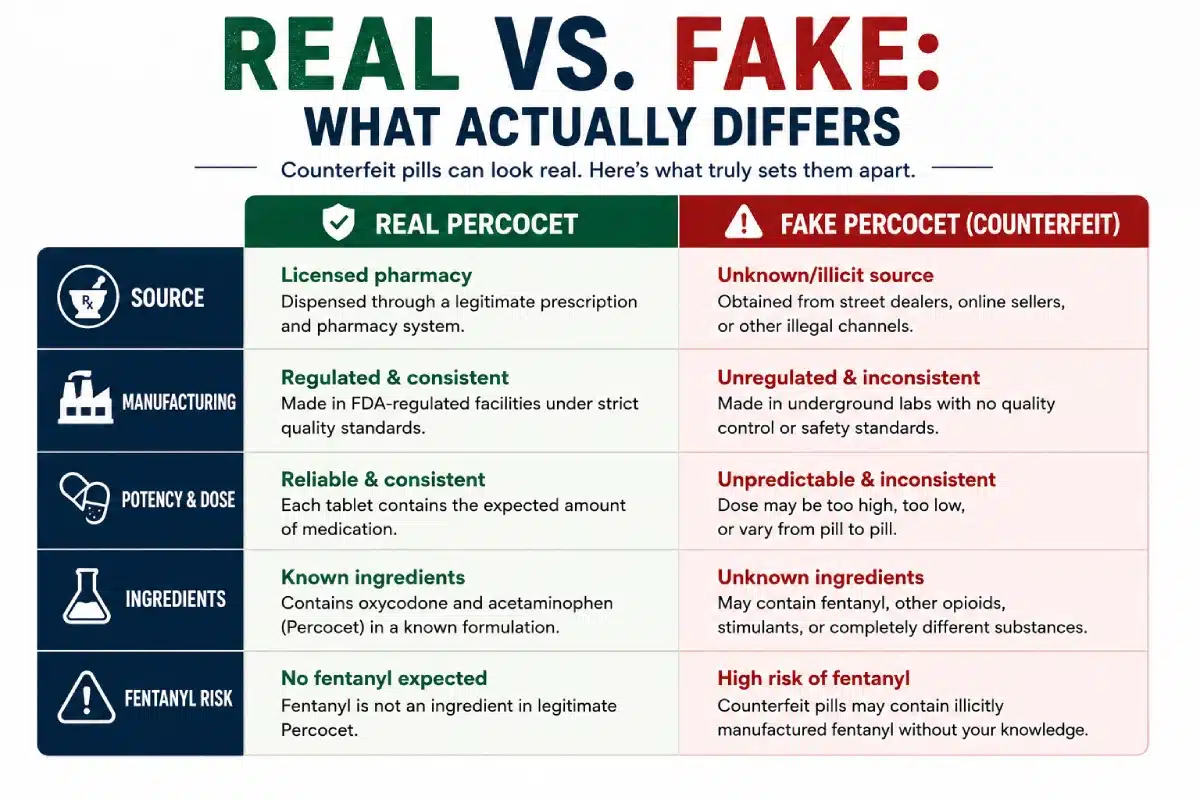
The differences that matter most have nothing to do with appearance. They come down to supply chain and regulation, which is exactly what a pill can’t reveal just by sitting in your hand.
Why Are Fake Percocet Pills So Dangerous?
Fake Percocet pills are dangerous because the person taking them often has no reliable way to know what the pill contains or how strong it actually is. The DEA’s fake prescription pills fact sheet states that illicit manufacturers use pill presses to reproduce markings and logos from legitimate medications, allowing pills containing fentanyl or other drugs to imitate familiar pharmaceutical products convincingly.
The danger is therefore not simply that a counterfeit pill is “strong.” The deeper problem is that the person taking it may have no dependable information about the dose, contents, or consistency of the tablet.
Two pills that look identical may not necessarily contain the same substance or potency.
Clinical Insight From Dr. Ash Bhatt: Fentanyl is roughly 50 times more potent than heroin and up to 100 times more potent than morphine. A dose difference that would be a rounding error in a legitimately manufactured oxycodone tablet can be the difference between a normal dose and a fatal one when the substance is actually fentanyl. That’s why DEA lab testing found 29% of pills seized with fentanyl in them contained a potentially lethal amount, and it’s also why “the last pill from this batch was fine” tells you almost nothing about the next one.
Can Fake Percocet Pills Contain Fentanyl?
Yes, counterfeit opioid pills can contain illicitly manufactured fentanyl, and there’s no way to detect it by sight, smell, or taste.
The CDC warns that illicitly manufactured fentanyl is increasingly pressed into counterfeit pills designed to resemble prescription oxycodone, and the DEA has separately flagged counterfeit M30 tablets containing fentanyl as a central part of the current counterfeit-pill threat.
Beyond fentanyl, the CDC’s hospital registry data found additional substances beyond fentanyl in roughly 9 out of 10 counterfeit M-30 exposure cases it reviewed, which is part of why the effects of taking one can look nothing like what someone anticipated.
Can You Tell If a Percocet Is Fake by Looking at It?
Not reliably. A counterfeit pill may reproduce the color, shape, imprint, and general appearance of a legitimate medication closely enough that visual inspection cannot establish authenticity.
This is one of the most important misconceptions to correct.
People sometimes assume that a fake pill will look poorly made, have a strange color, or contain an obviously incorrect imprint. That is not a dependable assumption. Counterfeit manufacturers can deliberately copy pharmaceutical markings and tablet designs.
DEA has documented authentic oxycodone M30 tablets alongside counterfeit M30 tablets containing fentanyl that were designed to resemble them.
The Department of Justice has also described a case involving counterfeit 30-mg oxycodone pills that were made to look real. The victim reportedly researched whether the pills were genuine but could not distinguish the counterfeit tablets before taking them.
So the safer principle is simple:
“A pill that looks real is not necessarily authentic, and an M30 imprint is not proof of safety.”
Appearance can help identify a legitimately manufactured prescription medication when the medication is already known to have come from a pharmacy. It cannot turn an illicitly obtained pill into a verified medication.
What Happens If Someone Takes a Fake Percocet?
The effects depend entirely on what the counterfeit pill contains. If it includes fentanyl or another potent opioid, the result can be opioid toxicity that develops faster and more severely than someone would expect from a standard Percocet dose.
Warning signs of opioid overdose include:
- Being unconscious or unable to wake up
- Slow, shallow, or stopped breathing
- Choking, gurgling, or unusual snoring sounds
- Pinpoint pupils
- Pale, gray, or blue-tinted lips or skin
The CDC notes that it can be difficult to distinguish severe intoxication from an overdose, so if there’s any doubt, it’s safer to treat the situation as an overdose.
Clinical Insights from Dr Ash Bhatt: Because fentanyl binds opioid receptors so strongly, a single standard dose of naloxone doesn’t always reverse a fentanyl-involved overdose the way it typically would with a prescription opioid. Emergency responders often need to give a second or third dose a few minutes apart. That means staying with the person and continuing rescue breathing between doses matters just as much as giving naloxone in the first place, and it’s exactly why calling 911 immediately, rather than waiting to see if one dose works, is the right first move.
Why Repeated Fake Percocet Use Can Become an Addiction Problem
A single counterfeit-pill exposure doesn’t automatically mean someone has an addiction. The concern grows when opioid use becomes a repeated pattern involving cravings, impaired control, tolerance, withdrawal, or continued use despite real harm.
Someone may start with a simple assumption: this is just a Perc. Repeated exposure to an unpredictable opioid supply can gradually change that picture, until the more accurate statement becomes that the person needs an opioid to feel normal.
Physical dependence and withdrawal alone don’t establish an opioid use disorder on their own, particularly during appropriate medical treatment. What matters clinically is the fuller pattern of behavior:
- Loss of control over how much or how often pills are used
- Strong or persistent cravings
- Increasing time spent obtaining pills
- Continued use despite health scares or life consequences
- Withdrawal symptoms when pills aren’t available
- Repeated failed attempts to cut back or stop
Why Someone May Keep Using Fake Percocet Even After Learning the Risk
Knowing that counterfeit pills are dangerous does not necessarily make stopping easy.
Someone may continue using because opioid use has become tied to tolerance, cravings, withdrawal avoidance, emotional relief, pain management, or a compulsive pattern of obtaining and taking pills.
Several forces can reinforce continued use:
- Tolerance: The same amount may no longer produce the expected effect.
- Craving: The desire to use can become difficult to ignore.
- Withdrawal: Someone who has developed physical dependence may use opioids partly to avoid becoming sick.
- Emotional reinforcement: Opioids may temporarily blunt distress, anxiety, trauma-related symptoms, or other uncomfortable emotions.
- False confidence: Previous pills may have appeared to be “fine,” creating the mistaken belief that the next pill will be equally predictable.
- Preoccupation: Obtaining pills can gradually take up more time, attention, and money.
This is why simply telling someone that counterfeit pills contain fentanyl may not resolve the underlying problem.
If the person has developed an opioid use disorder, the issue is no longer just knowledge of counterfeit-pill risks. The person may need medical and behavioral treatment that addresses dependence, cravings, withdrawal, and the circumstances driving continued opioid use.
When Does Fake Percocet Use Mean Someone Needs Professional Help?
Professional evaluation matters well before a catastrophic event, and there’s no reasonable version of this problem where waiting for an overdose is the right threshold. Consider reaching out for an assessment if someone:
- Uses pills more often or in larger amounts than intended
- Has tried and failed to stop repeatedly
- Spends significant time finding, buying, or recovering from pill use
- Experiences withdrawal when pills aren’t available
- Continues using despite health, relationship, or financial consequences
- Has already had an overdose or near-overdose but keeps using
- Hides pill use from family or loved ones
These signs point toward a developing opioid use disorder rather than an isolated exposure, and someone doesn’t need to wait for things to get worse before an assessment starts making sense.
How Is Counterfeit-Pill Use Evaluated Clinically?
A clinical assessment isn’t about proving whether one specific pill was genuine. A clinician typically wants to understand what the person believes they’ve been taking, where the pills came from, how frequently and for how long, and whether cravings, tolerance, or withdrawal have developed.
They’ll also look at whether other substances are involved, whether chronic pain or a mental health condition like anxiety, depression, or trauma is contributing to continued use, and how the pattern is affecting relationships, work, and daily functioning.
The more important question is “What is the person’s current pattern of opioid use, and what risks or symptoms has that pattern created?”
What Treatment Can Help With Fake Percocet or Opioid Addiction?
Treatment for someone who has developed opioid use disorder from counterfeit Percocet or M30 use generally focuses on both the medical effects of opioid dependence and the behavioral or psychological factors that sustain use.
Depending on the person’s needs, treatment may include:
- Medical assessment and stabilization
- Medically supervised withdrawal management
- Medication for opioid use disorder
- Individual therapy
- Group therapy
- Behavioral interventions
- Mental-health treatment for co-occurring conditions
- Relapse-prevention planning
- Family involvement when appropriate
- Continuing care and aftercare
SAMHSA identifies medications including buprenorphine, methadone, and naltrexone as evidence-based options used in the treatment of opioid use disorder. These medications work differently, but treatment is generally individualized according to the person’s clinical needs.
Medication is not necessarily a substitute for the rest of treatment. SAMHSA’s current guidance emphasizes patient-centered care and notes that many people with moderate or severe opioid use disorder benefit from medication treatment combined with services addressing broader clinical and psychosocial needs.
We incorporate opioid treatment into a broader continuum of care that can include medical detox, residential treatment, partial hospitalization, intensive outpatient care, outpatient treatment, therapy, and continuing recovery support.
The appropriate level of care depends on factors such as current opioid use, withdrawal risk, overdose history, medical needs, mental health, home environment, and previous treatment experiences.
The Bottom Line on Fake Percocet Pills
The most dangerous thing about a counterfeit Percocet pill is that you cannot reliably know what’s inside it just by looking. A person may believe they’re taking Percocet or oxycodone when what they’re actually taking is fentanyl, a different substance entirely, or a dose far stronger than expected.
If pill use has become repeated, difficult to control, or tied to cravings and withdrawal, the issue has moved past counterfeit-pill exposure into something Percocet addiction or broader oxycodone addiction treatment is built to address. Professional help is appropriate at that point, not as a last resort.
Helpful Resources
For overdose recognition and naloxone guidance, the CDC provides current information on fentanyl. For counterfeit-pill statistics and enforcement updates, the DEA’s Fake Prescription Pills resource and Get Smart About Drugs are both regularly updated. For medication-assisted treatment options, SAMHSA’s TIP 63 guide outlines evidence-based approaches to opioid use disorder.