


-
 By:
Valerie Puffenberger, PMHNP-BC
By:
Valerie Puffenberger, PMHNP-BC -
Editor:
Phyllis Rodriguez, PMHNP-BC
-
Clinical Reviewer:
Dr. Ash Bhatt, MD, MRO
 By:
By:
 Editor:
 Clinical Reviewer:
Key Takeaways
- Patients often don’t realize hydroxyzine can prolong the heart’s QT interval, and on top of that, when they add alcohol, it’s like stacking a cardiac rhythm risk on top of sedation most people never see coming.
- Hydroxyzine has a 20-hour half-life in adults, which means when patients tell me “I only drank the next morning,” their body may still be processing last night’s dose.
- Anticholinergic side effects like urinary retention and severe constipation get worse with alcohol, yet almost nobody researching this interaction is warned about that part.
Hydroxyzine and alcohol should not be mixed. It’s a direct warning printed on the FDA-approved drug label itself, because both substances suppress your central nervous system through overlapping pathways in the brain.
In this article, we’ll go beyond the basic “don’t do it” advice and explain the pharmacology behind why this combination is risky and which specific side effects to watch for. In addition to that, we will also discuss how long hydroxyzine realistically stays active in your body, when the interaction becomes a medical emergency, and why alcohol use alongside an anxiety medication sometimes signals a deeper issue worth addressing.
Can You Drink Alcohol While Taking Hydroxyzine?
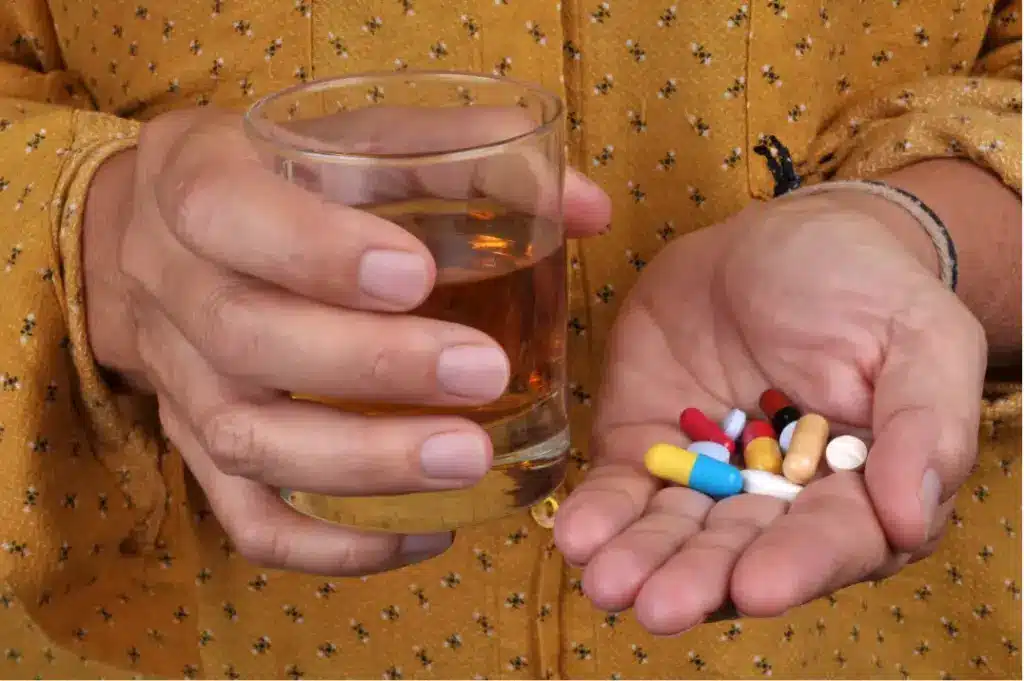
No. Hydroxyzine’s own FDA prescribing information explicitly instructs patients to avoid the simultaneous use of other CNS depressants. It warns that alcohol’s effects “may be increased” when combined with the drug, and it’s written directly into the medication’s official labeling.
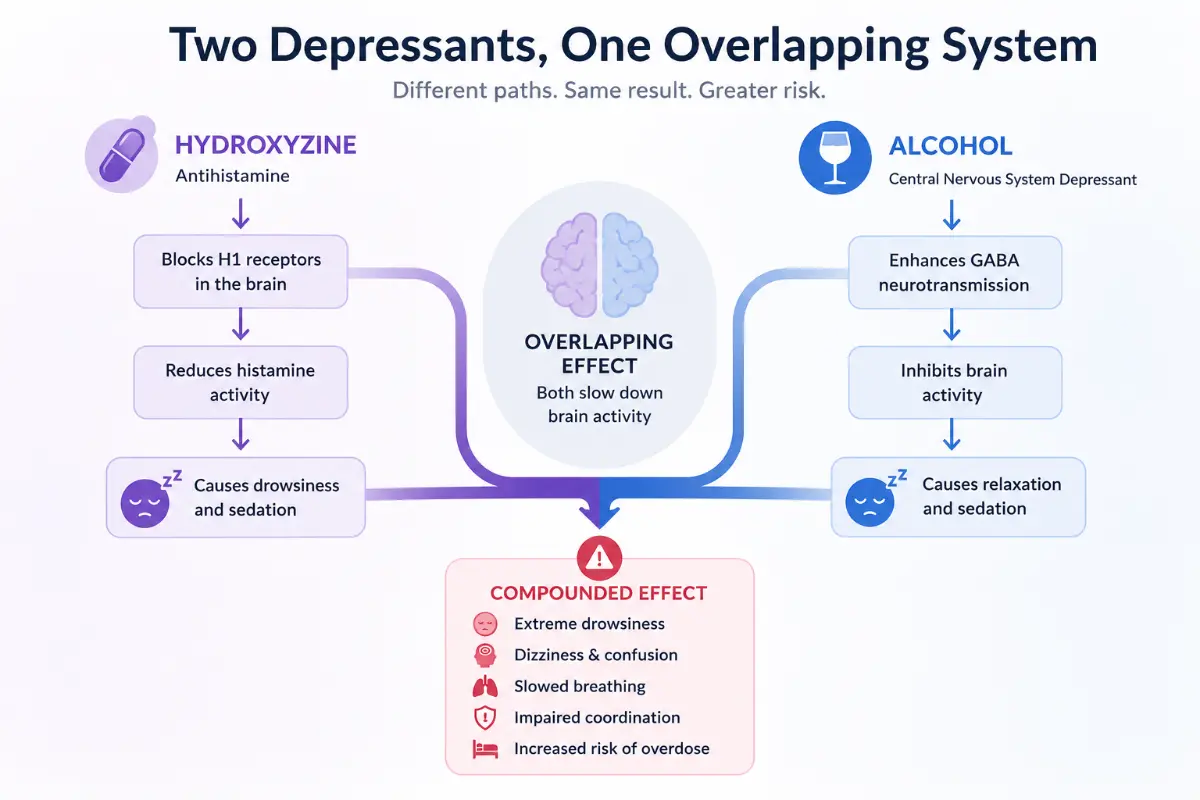
Here are the real biochemical and neurological mechanisms occurring in your body when you combine these two. Hydroxyzine is a first-generation antihistamine, and unlike the new allergy drugs, easily crosses blood brain barriers and blocks H1 histamine receptors in the brain, which is mainly responsible for the tranquillizing, sleeping effects of this drug. Alcohol by itself potentiates GABA action, which is one of the major “braking” neurotransmitters in our brains. When these two different modes of action are turned on together, instead of a small dose of sleepiness you get two depressant systems being on at the same time.
If you have been wondering, “my doctor prescribed hydroxyzine, is it alright to drink a bit? “, the real medical answer is simply that no amount of alcohol has yet been proven that can be safely combined with hydroxyzine. Your doctor can see much more than you including the other prescription drugs and medical conditions you may have, so it is best to talk to your doctor before drinking alcohol to find out what is your safe amount.
What Happens When You Mix Hydroxyzine and Alcohol?
When hydroxyzine and alcohol interact, the combined depressant effect compounds in a way that can feel disproportionate to what you actually consumed. A single drink on top of a normal hydroxyzine dose can produce impairment closer to what you’d expect from two or three drinks alone.
This happens because your liver is involved in processing both substances, and alcohol can interfere with how efficiently your body clears hydroxyzine. When clearance slows down, more of the drug stays active in your bloodstream, which extends and intensifies its sedating effects well past when you’d expect them to wear off.
The combination can intensify:
- Sedation – This means much more than just being sleepy; most patients say that they experience a feeling of being “pulled under” to such an extent that they almost don’t know if they are asleep or not.
- Dizziness -Both substances tend to cause drowsiness or changes in the blood pressure that might lead to feeling weak or dizzy even while standing up for some minutes.
- Impaired coordination – Fine motor capabilities, as well as balance deteriorate. This mainly results in the inability to perform precise tasks such as walking or standing.
- Slower reaction time – Response speed to sudden events, a car braking, a hazard on the stairs, drops measurably, which is exactly why driving after this combination is considered unsafe.
- Difficulty concentrating – Thoughts feel delayed or foggy, making conversations, work tasks, or even following a simple set of instructions noticeably harder.
Dr. Ash Bhatt’s Clinical Perspective: What surprises most patients is that hydroxyzine isn’t a controlled substance, so they mentally categorize it as “safer” than something like a benzodiazepine. Pharmacologically, that assumption doesn’t hold up, the sedation hydroxyzine produces, once alcohol is added, can rival what I see with much more heavily regulated medications.
What Are the Side Effects of Mixing Hydroxyzine and Alcohol?
Apart from the common sedative consequences, this combo produces adverse reactions linked to the other properties of hydroxyzine, in particular its anticholinergic properties, which are never elaborated in basic interaction warnings.
- Excessive sleepiness – Drowsiness so severe it persists far beyond normal medication-remnant sleepy feelings, and in few cases it can even lead to an inability to stay awake even after a full night of sleep.
- Dizziness – An ongoing sensation of unsteadiness or lightheadedness that may present even at rest, not only when standing or sitting up.
- Poor coordination – Clumsy performance during simple activities that are normally performed smoothly and automatically, such as struggling to walk a line or drop small objects.
- Nausea – Stomach discomfort that may be caused by either of the two having an adverse effect on the gastro-intestinal system and/or the nausea-control centers of the brain.
- Confusion – Difficulty following conversations, keeping in mind what you just said, or understanding your environment, mainly in the elderly.
- Impaired judgment – Reduced ability to accurately assess your own level of impairment, which is often the most dangerous effect because it directly shapes the decisions you make next, like whether to drive.
There is also a less-commonly discussed risk that may be worth explicitly mentioning: hydroxyzine has a known, dose-dependent propensity to prolong the QT interval, the electrical circuit through which your heart beats. Case reports in medical literature have linked hydroxyzine to a rare but serious heart rhythm disturbance called torsade de pointes, particularly in people with existing heart conditions, electrolyte imbalances, or other medications that affect heart rhythm. While alcohol itself does not theoretically cause this problem, excessive or chronic consumption has been demonstrated to induce electrolyte abnormalities, which raises the underlying risk factors this cardiac warning is built around.
When Can the Interaction Become Dangerous?
Majority of persons who use hydroxyzine and drink alcohol will just experience all those mentioned effects without any further serious situation. And yet, there is quite a significant difference between annoying side effects and harmful side effects, and it’s important to know where that line sits.
You should go to a doctor or a hospital straight away if you notice any of these signs:
- Extreme difficulty staying awake, rather than simply feeling very tired.
- Slow, shallow, or labored breathing, since both substances together can suppress the brain’s respiratory drive when taken in greater concentrations.
- Bluish tint to the lips or fingertips, which is a clear outward sign that there is a significant oxygen deficiency in the blood.
- Irregular heartbeat, chest discomfort, or fainting, which may be indicative of the risk to cardiac rhythm risk.
- Unresponsiveness, which refers to the inability of a person to wake up despite loud voice or physical touching.
None of these signs should be “watched and waited out” at home. They call for emergency care.
Is One Drink Safe While Taking Hydroxyzine?
There’s no universal amount of alcohol that can be labeled safe for every person taking hydroxyzine, and anyone offering a specific “safe number” isn’t accounting for how differently this medication behaves from person to person.
Your individual risk depends on several factors working together, not any single one in isolation:
- Your personal sensitivity to hydroxyzine – Some people feel pronounced sedation even at low doses, while others tolerate the same dose with minimal drowsiness, and this baseline sensitivity directly shapes how alcohol will affect you.
- Underlying health conditions – Liver impairment slows how quickly hydroxyzine is cleared from your system, while kidney issues or existing heart conditions raise the stakes of both the sedative and cardiac risks.
- Other medications you’re taking – Anything with its own sedating, anticholinergic, or QT-prolonging properties, including certain antidepressants, antipsychotics, or antibiotics, compounds the risk further when alcohol enters the picture.
- How much and how quickly you drink – A single drink consumed slowly with food affects you differently than the same drink consumed quickly on an empty stomach, and hydroxyzine amplifies that variability.
- Your age – Older adults process hydroxyzine more slowly and are more sensitive to both its sedative and anticholinergic effects, meaningfully lowering the threshold at which problems appear.
Because these variables interact in ways that aren’t predictable from the outside, this is a question best answered by your prescriber, who can weigh your specific dose and health history, not by a general guideline.
Hydroxyzine and Alcohol: How Long Should You Wait?
There’s no single waiting period that applies to everyone, but understanding hydroxyzine’s actual timeline in your body explains why “I waited a few hours” is often not enough.
Hydroxyzine’s noticeable calming effects typically peak within about two hours and are often described as fading within four to six hours. That timeline is misleading on its own, though, because it only reflects when the sedation feels less noticeable, not when the drug has actually left your system.
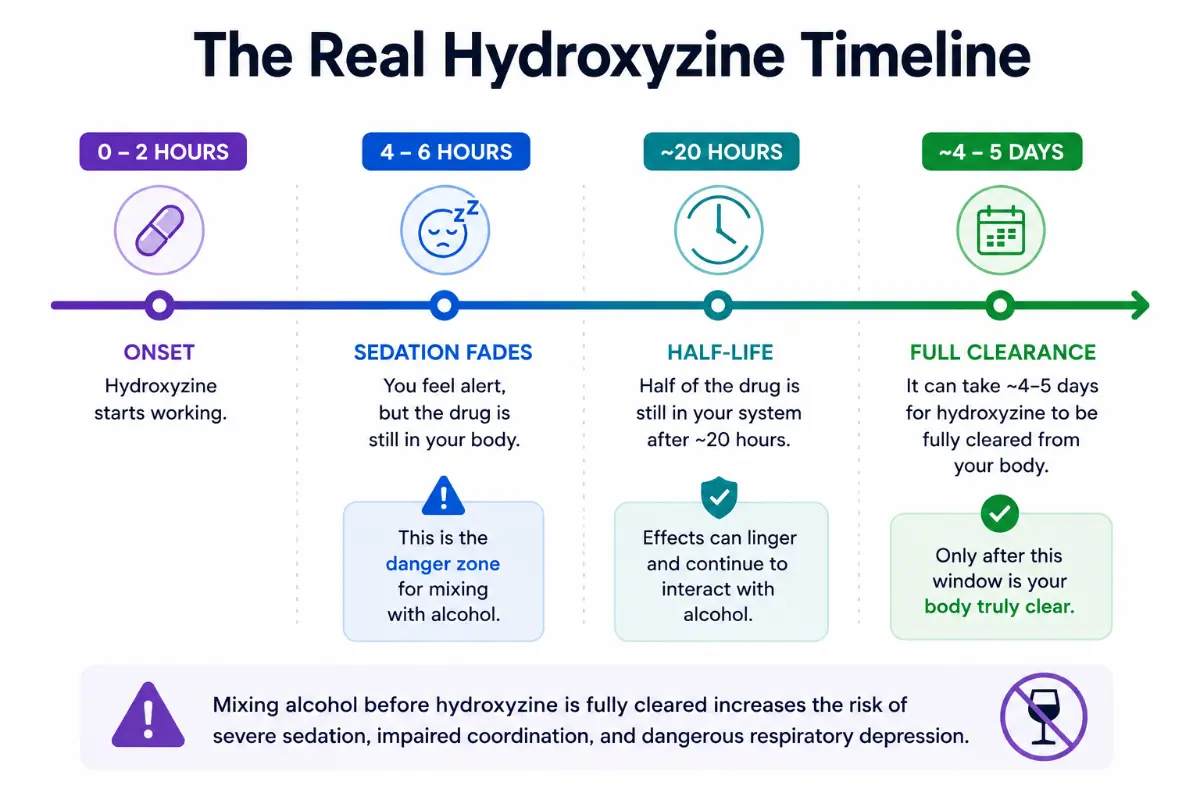
Clinical pharmacokinetic data show hydroxyzine’s elimination half-life in healthy individuals to be approximately 20 hours. Elderly subjects are more likely to see an increase in this number, occasionally reaching 30 hours. Since it typically takes about five half-lives for a drug to be considered functionally cleared, hydroxyzine can remain present in your body for four to five days after a single dose, even though you stopped feeling drowsy long before that.
Several factors shift this timeline further:
- Individual metabolism – Liver enzymes that detoxify the drug differ drastically, two people who get prescribed the same quantity of a drug can actually end up having the drug excreted by different timeframes in their bodies.
- Age – It is the function of liver and kidneys that goes down with age. That is why seniors retain hydroxyzine drug longer within their bodies.
- Health factors – Liver or kidney impairment slows clearance further, which extends both how long the drug stays active and how long the alcohol interaction risk remains relevant.
- Other medications – Drugs that compete for the same liver enzymes hydroxyzine relies on for metabolism can slow its clearance, unintentionally extending its presence in your system.
- Formulation – Both hydroxyzine pamoate and hydroxyzine HCl contain the same active substance. Because of this, the duration worry mentioned above will be valid regardless of whether hydroxyzine pamoate or hydroxyzine HCl is administered.
Given how long hydroxyzine actually stays active, guessing at a personal cutoff isn’t a reliable safety strategy, a direct conversation with your prescriber about timing, based on your specific dose and health profile, is.
Can You Overdose on Hydroxyzine and Alcohol?
Yes. Taking hydroxyzine in excessive amounts can cause serious toxicity on its own, and alcohol worsens the sedation and other adverse effects that come with it. This risk isn’t typically associated with hydroxyzine taken exactly as prescribed, it climbs when doses exceed what’s recommended, when hydroxyzine is combined with other CNS depressants, or when alcohol consumption is heavier.
The FDA’s labeling for hydroxyzine specifically flags this potentiating risk with alcohol and other sedating substances, and that warning reflects real documented cases, not a theoretical caution.
Warning signs that require emergency medical attention include:
- Extreme, unrousable drowsiness – A depth of sedation where the person cannot be woken by voice or touch, distinct from ordinary heavy sleepiness.
- Confusion or disorientation that doesn’t resolve – Difficulty recognizing familiar people, places, or time, lasting beyond what would be expected from simple tiredness.
- Slowed or difficult breathing – Breaths that are shallow, irregular, or noticeably slower than normal, signaling that the CNS depression has reached a dangerous level.
- Irregular heartbeat or loss of consciousness – Given hydroxyzine’s documented QT-prolongation risk, cardiac symptoms combined with sedation should be treated as an emergency, not monitored at home.
If you witness these signs in yourself or someone else after combining hydroxyzine and alcohol, this calls for immediate emergency care.
Why Can Alcohol Be a Problem When Taking Hydroxyzine for Anxiety?
For many people prescribed hydroxyzine specifically for anxiety, the pull toward alcohol isn’t really about the drug interaction; it’s about wanting relief that feels immediate. Anxiety can be exhausting to sit with, and alcohol offers a fast, familiar sense of calm that a prescription, by comparison, can feel slow to deliver.
That relief is short-lived, though, and it doesn’t touch the underlying cause of the anxiety. As alcohol metabolizes and its effects wear off, many people experience rebound anxiety, a temporary spike in anxious symptoms that can feel more intense than what they were trying to escape in the first place.
Left unaddressed, this can settle into a repeating cycle:
- Anxiety builds, and alcohol is used as a fast-acting way to bring the intensity down in the moment.
- Relief fades quickly, and rebound anxiety follows once alcohol’s effects wear off, often within hours.
- More alcohol starts to feel necessary just to reach the same sense of calm, as tolerance to its calming effect builds over repeated use.
- Reliance on alcohol for relaxation, sleep, or emotional regulation deepens, gradually replacing healthier coping strategies the person may have relied on before.
Dr. Ash Bhatt’s Clinical Perspective: In my practice, the individual instance of drinking on hydroxyzine is rarely what worries me most. What concerns me is when I see alcohol quietly become someone’s actual anxiety management strategy, while the prescribed medication becomes an afterthought. That’s a fundamentally different clinical picture than a one-time risky decision, and it calls for a different conversation.
When this pattern overlaps with an anxiety medication that’s also a CNS depressant, the risks compound in both directions, the interaction becomes more likely, and the underlying anxiety becomes harder to treat effectively.
When Alcohol and Anxiety May Require Professional Treatment
Certain patterns suggest this has moved beyond an occasional risky choice and into territory where professional support can make a real difference:
- Regularly drinking specifically to manage anxiety symptoms, rather than drinking occasionally in social settings unrelated to how you’re feeling emotionally.
- Finding it difficult to cut back, even after recognizing the pattern and genuinely wanting to change it.
- Continuing to drink despite knowing about the interaction risk, which often signals that the pull toward alcohol has outweighed awareness of the danger.
- Alcohol interfering with how well your treatment works, including reduced effectiveness of hydroxyzine itself or difficulty engaging consistently in therapy.
- Anxiety and drinking reinforcing each other, where each one makes the other harder to manage, creating a loop that feels increasingly difficult to break alone.
- Alcohol or anxiety symptoms affecting work, relationships, or daily functioning, in ways that are noticeable to you or to the people around you.
When anxiety and problematic alcohol use show up together, treating only one side of that equation rarely produces results that hold up over time. Integrated care that addresses both the anxiety and the drinking pattern simultaneously tends to be more effective than treating them as separate, unrelated issues.
At Legacy Healing Center, our dual diagnosis treatment approach is built specifically around this overlap, recognizing how closely anxiety and alcohol use can become intertwined. If any of these patterns sound familiar, reaching out to a treatment provider isn’t a last resort, it’s a way to address both pieces of the picture at the same time, with support that’s actually built for it.