


-
 By:
Alex Herrera
By:
Alex Herrera -
Editor:
Phyllis Rodriguez, PMHNP-BC
-
Clinical Reviewer:
Dr. Ash Bhatt, MD, MRO
 By:
By:
 Editor:
 Clinical Reviewer:
Key Takeaways
|
If you’ve been searching for fentanyl in weed, you are not alone, and you are asking exactly the right question. Over the past few years, this concern has moved from fringe forums into mainstream public health conversations, and understandably so. The fentanyl crisis has reshaped everything we thought we knew about drug safety, including which substances people assume are relatively low-risk.
This article will walk you through what we actually know about cannabis contamination in illicit markets, the warning signs that may indicate such contamination, and why taking unregulated cannabis products can be dangerous in many ways.
So, whether you are a worried parent, a casual cannabis user, or a person who is helping someone with a substance use, this information is worth understanding clearly.
|
Can Weed Be Laced with Fentanyl?
Yes, it can, though how frequently this actually happens is more difficult to confirm than many reports suggest. The core question of whether marijuana laced with fentanyl exists has been answered by documented cases from public health agencies, but the prevalence and circumstances vary significantly by region and market.
It may not be actually intentional that sellers are mixing fentanyl in cannabis because it could be a cross-contamination during processing, shared equipment, or dishonest distribution practices that get mixed up into a product that shouldn’t contain them. This same uncertainty is the problem, because buyers in the illicit market can not verify what they are purchasing.
Some public health departments have issued alerts about contaminated cannabis batches. Others have found that overdose cases initially attributed to laced weed were tied to polysubstance use, where fentanyl was consumed separately. This variability in reporting makes it important to approach the topic with measured concern rather than blanket certainty in either direction.
Why People Are Worried About Fentanyl Mixed with Weed
The concern about fent weed has grown alongside the broader fentanyl overdose crisis, which has fundamentally changed how people think about illicit drug safety. Fentanyl is now found in drug supplies that historically never contained it, pressed pills, powders, and increasingly, plant-based substances. That track record has given people every reason to be vigilant.
Several factors are driving this specific concern:
- Social media has amplified anecdotal reports, some credible, others exaggerated, making it genuinely difficult for the average person to distinguish between confirmed contamination cases and speculation.
- Counterfeit drug production has scaled up dramatically, with illicit manufacturers frequently using shared equipment that can introduce fentanyl across product lines.
- Overdose awareness has grown, and people who previously assumed cannabis was low-risk are now asking harder questions about what unregulated markets actually guarantee.
The fear itself is not irrational. It reflects a reasonable response to a supply chain that operates entirely outside medical or regulatory oversight.
Why Experts Urge Caution with Online Reports
Not every overdose case linked to cannabis is confirmed contamination, and that distinction matters. Toxicology reports take time. People sometimes use multiple substances simultaneously, and the substance responsible for an adverse reaction may not be what the person believed they were taking. This doesn’t make the concern less serious, it makes accurate information more important.
Misinformation spreads faster than lab results, and sensationalized headlines can create public health challenges of their own, including eroding trust in legitimate warnings when they do emerge. The authoritative guidance is this: illicit substance supplies are inherently unpredictable, and that unpredictability itself is the safety concern, regardless of how widespread any specific type of contamination is.
| Clinical Perspective from Dr. Ash Bhatt “If someone comes into the clinic or calls me and asks if it’s true that marijuana is being contaminated, I don’t just tell them not to worry. Instead, I bring the discussion back to what they can do about it. We all know that illegal markets cannot be trusted. We also know that fentanyl has been found in some places where you wouldn’t expect it. Given those facts, any product without third-party testing should be treated as potentially unpredictable.” |
Can You Tell If Weed Is Laced?
No. There is no reliable visual, smell-based, or tactile method to detect whether cannabis has been contaminated with fentanyl or any other adulterant. This point cannot be overstated, people regularly assume they can spot a problem by looking at their product closely, and that assumption is clinically inaccurate.
Fentanyl is active in doses measured in micrograms, quantities far too small to see, smell, or feel on a cannabis product. A contaminated product looks, smells, and handles identically to an uncontaminated one. Visual inspection tells you nothing meaningful about chemical composition.
Fentanyl test strips, available in many communities, can detect fentanyl in residue or dissolved solutions, though they were not originally designed for use with plant material and results can vary. They are still considered a harm reduction tool worth having access to, but they are not a guarantee of safety.
What Does Laced Weed Feel Like? Recognizing Overdose Warning Signs
This question is critical for anyone who uses cannabis or is around someone who does, it is because the effects of laced cannabis are not the same as a stronger-than-expected marijuana experience. They are the signs of opioid toxicity, and they require emergency intervention.
Some of the overdose warning signs to watch for include:
- Sudden, extreme sedation, far beyond typical cannabis drowsiness
- Slowed, shallow, or stopped breathing
- Severe confusion or unresponsiveness
- Dizziness or loss of muscle control
- Blue or grayish lips or fingertips (cyanosis)
- Loss of consciousness that cannot be reversed by calling out or touching
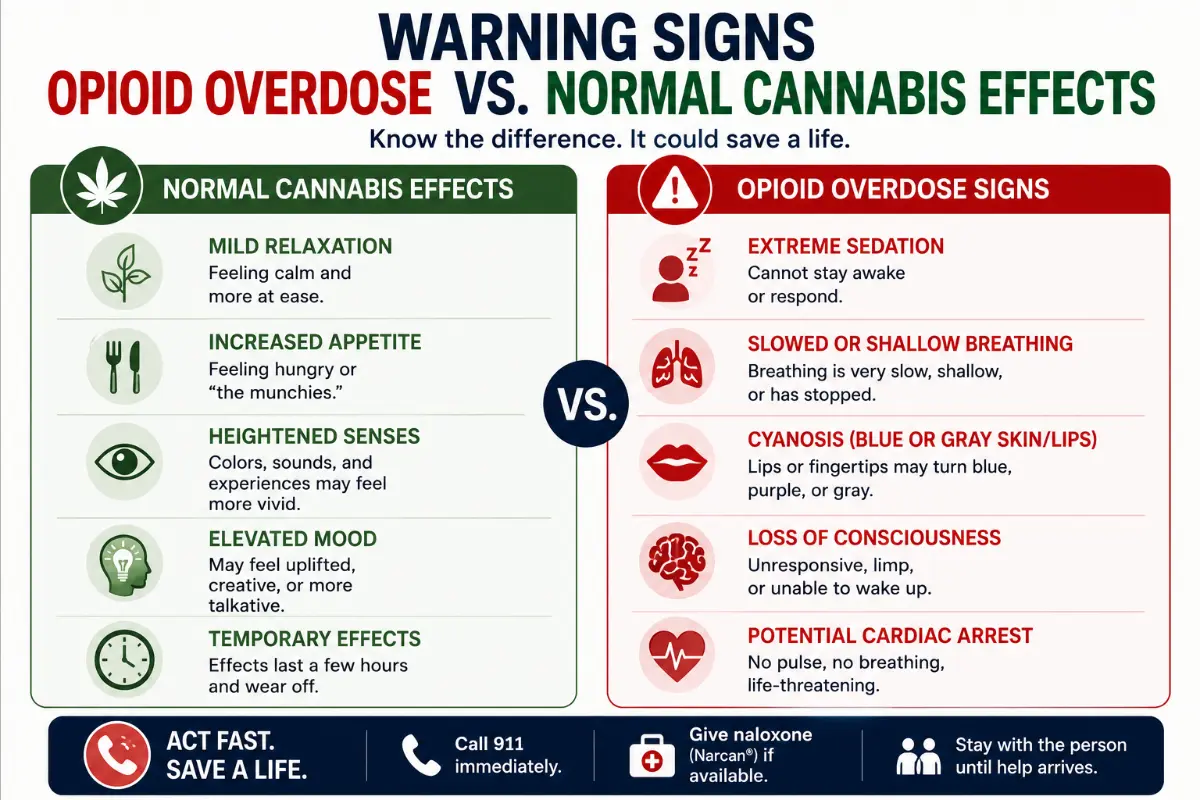
| Important disclaimer: Symptoms vary depending on the substance involved, the dose, and individual factors like body weight and prior substance use. These signs indicate any serious overdose-level event that requires emergency care. |
What Happens If Exposure Occurs
If you suspect someone has been exposed to a contaminated substance and is showing any of the warning signs above, regardless of what the substance was supposed to be, treat it as a medical emergency.
Steps to take immediately:
- Call 911 right away – do not wait to see if the person improves on their own.
- If naloxone (Narcan) is available, administer it – it can reverse opioid overdose and has no harmful effect if the substance was not an opioid.
- Place the person in the recovery position if they are unconscious but breathing.
- Do not leave them alone, and do not attempt to self-diagnose the situation or assume the symptoms will pass.
Time is the most critical variable in an opioid overdose and every minute without intervention reduces the likelihood of a full recovery.
What Does Fentanyl Look Like in Weed? Understanding Contamination Appearance
This is one of the most searched questions on this topic, and the answer requires clarity: fentanyl in weed’s appearance is effectively invisible to the human eye. Fentanyl is a white, odorless powder in its pharmaceutical form, but in illicit supply chains, it can exist in various forms, all of which are detectable only through chemical testing.
Even a lethal dose of fentanyl is measured in micrograms; approximately 2 milligrams can be fatal for a non-tolerant person. That quantity is invisible to the naked eye when distributed across a cannabis product. There is no white powder that will look “off,” no unusual texture, and no detectable smell. Visual inspection of cannabis for fentanyl contamination is not a reliable or meaningful safety measure.
Risks of Fake THC Carts and Unregulated Cannabis Products
The concern about contaminated cannabis products is especially significant in the vape and cartridge market. A fentanyl laced cart poses a specific and serious risk because the delivery mechanism, heating a concentrated oil and inhaling it, is faster-acting than smoking plant material, meaning exposure effects can onset very quickly.
Fake THC carts are among the most commonly counterfeited cannabis products. They are sold in packaging that closely mimics licensed brands, and without laboratory testing, there is no way to distinguish them from legitimate products. The risks in unregulated vape products include:
- Unknown additives, including synthetic cannabinoids, cutting agents, or opioids
- No regulatory oversight or third-party quality testing
- Variable potency that can be far higher or lower than labeled
- Contamination from shared or poorly maintained manufacturing equipment
Licensed dispensaries in states with legal cannabis markets test their products for contaminants. That testing infrastructure simply does not exist in black-market channels, and that gap is where the safety risk lives.
Clinical Perspective from Dr. Ash Bhatt“The area where I’ve been seeing the most danger at present is the counterfeit vape market. In fact, I’ve had some patients who, found themselves in a situation of harm because the package looked so official that they thought they were being very cautious. And that’s how these products are designed to look. If there is no analysis certificate from a licensed laboratory, you are making a decision with incomplete information about what you’re actually consuming. “ |
What Parents and Families Should Know
For parents and family members, the question of fentanyl in cannabis products is definitely alarming. However, parents must not panic and instead understand the risks and actually be prepared for any such emergencies.
What matters most:
- Understanding that illicit cannabis, anything purchased outside a licensed dispensary, carries contamination risk that state-regulated products do not.
- Knowing the overdose warning signs, not to monitor compulsively, but because recognizing them quickly is what saves lives.
- Having naloxone at home. It is available over the counter in most states, it is inexpensive, and it has no downside to having it available even if it’s never needed.
- Opening conversations about substance use without shame or accusation, young people who feel they can come to you with concerns are far less likely to be in situations where they use alone and help is unavailable.
When to Seek Addiction Treatment
If someone’s cannabis use has become a source of concern, whether related to frequency, dependency, or the risks of an unregulated supply, that concern itself is worth taking seriously. The risk of contamination in illicit markets is one reason to consider what treatment options look like.
There are a lot of treatment programs available for Fentanyl addiction, ranging from medical detox for acute withdrawal management to long-term outpatient support. If fentanyl or opioid use is involved along with addiction, whether it was through intentional use or accidental exposure, opioid detox under medical supervision is the safest starting point.
At Legacy Healing Center, treatment options are available that includes:
- Medical detox: Supervised withdrawal with the help of medication treatment to reduce discomfort and health risk.
- Rehab for fentanyl addiction: Both, residential and outpatient programs are available that address the psychological and behavioral aspects of opioid dependence.
- Dual diagnosis care: Integrated treatment for co-occurring mental health conditions that often underlie or lead to substance abuse.
Recovery doesn’t require reaching a crisis point before it becomes available. If you’re concerned about your own use or someone you care about, speaking with an addiction specialist is the most direct path to understand what support looks like.