


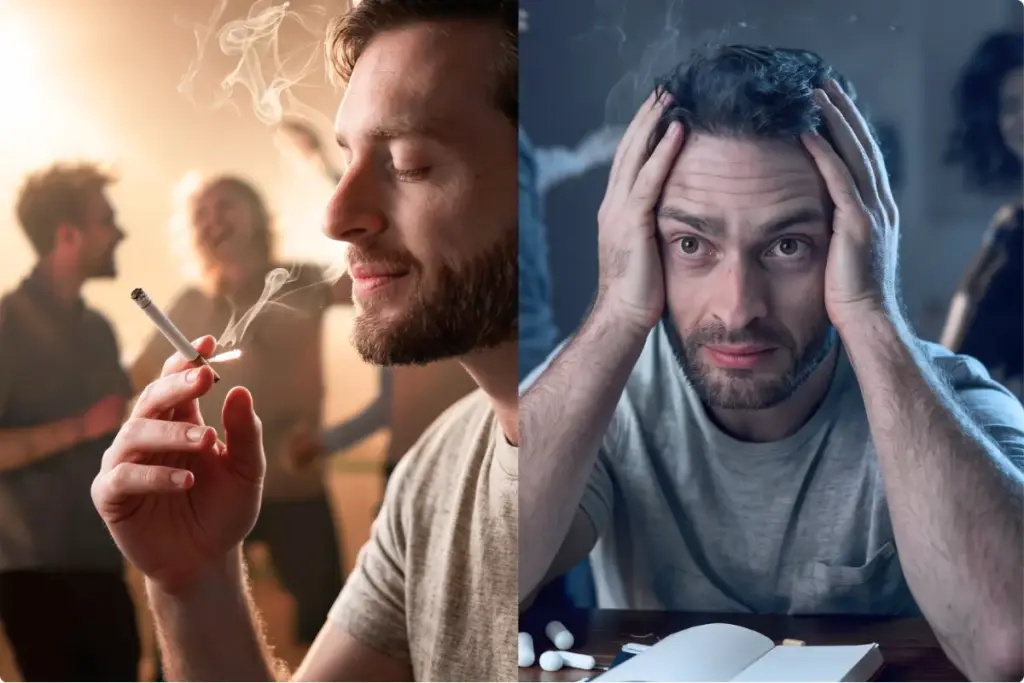
How Marijuana Use Is Masking Your Mental Health Issues
-
 By:
Valerie Puffenberger, PMHNP-BC
By:
Valerie Puffenberger, PMHNP-BC
-
 Editor:
Phyllis Rodriguez, PMHNP-BC
Editor:
Phyllis Rodriguez, PMHNP-BC
-
 Clinical Reviewer:
Dr. Ash Bhatt, MD, MRO
Clinical Reviewer:
Dr. Ash Bhatt, MD, MRO
I did not set out to question marijuana.
For much of my career, sitting across from patients in exam rooms, in addiction clinics, in psychiatric wards, cannabis was rarely the headline. Alcohol dominated. Opioids devastated. Methamphetamine ravaged lives with frightening speed.
Marijuana? It was often described as benign. Natural. Safer.
But over the past decade, something changed.
Patients began arriving not in crisis from marijuana itself, but stalled. Blunted. Unmotivated. Emotionally flat. Others came with anxiety that seemed resistant to treatment. Some had psychotic breaks that were difficult to untangle. And in nearly every case, there was a steady thread running beneath the surface:
“I smoke to calm down.”
“I use edibles to sleep.”
“It helps my anxiety.”
“It keeps my depression manageable.”
At first glance, that sounds reasonable. But the deeper I looked, the more I realized something unsettling:
Marijuana wasn’t always causing the primary problem. It was often masking it.
“According to SAMHSA’s 2024 National Survey on Drug Use and Health, approximately 21.2 million adults in the U.S. are living with both a mental health condition and a substance use disorder, yet most never receive treatment for both at the same time.””
Key Takeaways
|
When Feeling Better Is Not the Same as Getting Better
Cannabis can dull distress. That is part of its appeal.
Tetrahydrocannabinol (THC) alters mood perception. It can temporarily reduce anxiety, elevate mood, soften intrusive thoughts, and promote sleep. For someone struggling silently, it can feel like the first breath of air after weeks underwater.
But relief is not the same as resolution.
And when relief becomes routine, it can obscure the true shape of what lies beneath.
Below are five of the most common mental health conditions I’ve seen hidden behind habitual marijuana use, conditions that deserve real treatment, not just chemical quiet.
1. Anxiety Disorders: When Calm Isn’t Stability
Many people begin using marijuana to manage anxiety, social anxiety, generalized anxiety, panic symptoms. Initially, it works. The body relaxes. Thoughts slow down. Social interactions feel easier.
But here’s what often happens over time:
- Tolerance develops, and higher doses are needed for the same calming effect
- Anxiety begins to rebound when not using
- Baseline anxiety, the everyday resting level, actually increases
Meanwhile, the underlying anxiety disorder remains undiagnosed.
In clinical practice, I’ve seen individuals who believed they had “mild nerves” for years, until they stopped using cannabis and experienced full panic attacks for the first time. The marijuana had been dampening symptoms just enough to prevent proper diagnosis.
High-potency THC can also provoke anxiety and paranoia in susceptible individuals, meaning what started as self-medication becomes part of the very cycle it was meant to break.
The real cost isn’t just delayed relief. It’s delayed access to treatments that actually work, like cognitive behavioral therapy, trauma therapy, and appropriate psychiatric care, that address anxiety at its root.
2. Depression: The Slow Fade
Depression rarely announces itself. More often, it creeps in.
Low motivation. Emotional numbness. Disrupted sleep. A slowly shrinking social world.
Now layer marijuana on top of that.
Cannabis can temporarily elevate mood or soften emotional pain. But it also affects dopamine regulation, the very system involved in motivation, pleasure, and reward.
Over time, heavy use can contribute to apathy, reduced drive, emotional flattening, and social withdrawal. When someone is using daily, it becomes genuinely difficult to separate what is depression from what is cannabis-induced amotivation.
I’ve treated patients who insisted they were “just laid back.” But when they reduced or stopped marijuana, profound depressive symptoms surfaced, symptoms that had been partially muted for years. Conversely, I’ve also seen patients whose cannabis use was actively worsening their depression, but because marijuana was associated with temporary relief, they couldn’t see the connection.
The masking works both ways. It conceals severity. And it clouds cause.
3. Trauma and PTSD: Numbing vs. Healing
This is one of the most common patterns I encounter.
Someone with trauma, childhood abuse, military service, assault, medical crisis, struggles with hypervigilance, intrusive memories, or sleep disturbances. They discover that marijuana quiets the noise. It reduces nightmares, softens triggers, blunts emotional spikes.
For a person exhausted by trauma symptoms, this can feel lifesaving.
But effective trauma therapy requires emotional processing. It requires tolerating, in a safe, structured setting, the very feelings marijuana is suppressing. When cannabis becomes the primary coping tool, post-traumatic stress disorder symptoms may never fully surface in a way that leads to real treatment. The nervous system remains dysregulated beneath the chemical quieting.
In some cases, marijuana also interferes with memory processing, complicating therapies like EMDR that rely on narrative reconstruction and emotional integration.
Numbing is not healing. And while some supervised medical uses of cannabis are being studied, unsupervised daily use frequently becomes avoidance disguised as coping.
4. ADHD: The Fog That Hides the Fire
Adult ADHD is profoundly underdiagnosed. Many adults present with restlessness, difficulty focusing, impulsivity, emotional reactivity, and chronic underachievement, and quietly begin using marijuana to “slow their brain down.”
In the short term, cannabis may reduce hyperactivity or mental chatter. But long-term use can impair attention, working memory, and executive function, the very cognitive domains already challenged by ADHD.
I’ve seen adults misattribute lifelong ADHD symptoms to “just being a little scattered,” while marijuana use simultaneously masked the hyperactivity and worsened cognitive clarity. By the time they sought help, separating substance effects from baseline neurodevelopmental issues was genuinely difficult. A proper diagnosis, and the effective treatment that follows it, had been delayed for years.
5. Early Psychosis: The Most Dangerous Mask
This is where the stakes rise significantly.
There is strong evidence linking high-potency THC use with increased risk of psychosis in vulnerable individuals, particularly adolescents and young adults. But the more subtle problem is this: early psychosis can look like anxiety, depression, social withdrawal, or mild paranoia.
If someone is using marijuana regularly, emerging symptoms can be misattributed to stress or dismissed as cannabis side effects. Families may assume the behavioral changes are “just the weed.” Meanwhile, untreated psychosis progresses.
Early intervention in psychotic disorders dramatically improves outcomes. Delayed diagnosis worsens prognosis. When marijuana muddies the diagnostic picture, we lose time we cannot get back.
Marijuana Is Easier to Get Than a Therapy Appointment, And That’s a Problem
Twenty years ago, access required effort. Today, marijuana is legal in many states, commercially marketed, engineered for higher THC potency, and available in discreet forms, vapes, edibles, concentrates.
Walk into a dispensary and you may see products marketed for anxiety, sleep, focus, and mood enhancement, sometimes positioned, subtly or overtly, as alternatives to therapy or psychiatric medication.
For individuals wary of stigma or skeptical of mental health care, cannabis can appear to be a simpler solution. No appointments. No diagnosis. No vulnerability.
But symptom suppression is not equivalent to treatment. We are witnessing a quiet cultural shift where some people replace formal mental health care with self-directed cannabis regimens, often without realizing what may be building beneath the surface.
How to Tell If Someone You Love Is Coping Or Hiding
If someone you care about uses marijuana regularly, it can be hard to know what’s normal and what’s worth a closer look. These questions are not accusations, they are invitations to look deeper:
- Has their motivation or personality noticeably changed over time?
- Do they rely on marijuana to handle any form of emotional discomfort?
- Have they avoided seeking therapy because “weed helps enough”?
- Do symptoms worsen significantly when they try to stop?
The goal here is not to demonize marijuana. It is to recognize that it can blur the clinical picture, sometimes in ways that delay care that could genuinely change someone’s life.
The Question That Changes Everything
After years in this field, I no longer ask patients whether marijuana helps.
I ask: “What happens when you don’t use it?”
- If anxiety spikes dramatically, there may be an anxiety disorder underneath.
- If mood crashes, depression may be present.
- If sleep becomes impossible, unaddressed trauma or severe anxiety may be the cause.
- If paranoia intensifies, careful and prompt evaluation is needed.
Marijuana can be a coping tool. But when it becomes the primary regulator of mood, sleep, or stress, it may be compensating for something that deserves proper attention, and proper care.
A Call for Curiosity, Not Shame
This is not a moral argument. It is a clinical one.
If you use marijuana, consider honestly whether it is enhancing your life occasionally, or holding your mental health together daily.
If you’re unsure, that uncertainty alone is worth exploring with a qualified mental health professional. Because the most dangerous mental health conditions are not always the loudest ones. Sometimes they are quiet, softened by smoke, sweetened by edibles, hidden in plain sight.
And by the time we finally see them clearly, they have often been there much longer than we realized.
If marijuana is helping you cope, that matters. But if it is masking something deeper, that matters even more.
| You don’t have to figure this out alone.
If you’re wondering whether what you’re feeling goes beyond cannabis, our team at Legacy Healing is here to help you find out. We offer comprehensive mental health and dual diagnosis evaluations – no shame, no judgment, just clarity. Reach out today at 888-534-2295 |
Frequently Asked
Questions about Marijuana
Can marijuana cause mental health problems or does it just hide them?
Both can be true, for some people, regular marijuana use, particularly high-potency THC, can actively worsen or even trigger mental health conditions like anxiety, depression, and in vulnerable individuals, psychosis. For others, the marijuana is masking one that was already there. Either way, the result is the same: the underlying condition goes untreated, and over time, that silence has a cost.
How do I know if I'm self-medicating with marijuana or just using it recreationally?
The clearest indicator is dependency on it for emotional functioning. Ask yourself: What happens when you don’t use it? If anxiety spikes sharply, your mood crashes, sleep becomes impossible, or daily life feels unmanageable without it, that’s no longer recreational use. That’s regulation.
Can marijuana use delay a mental health diagnosis?
Yes, and this is one of the most clinically significant risks of habitual use. When marijuana consistently dampens symptoms, those symptoms may never fully surface in a way that triggers a proper evaluation. Panic attacks get softened into “mild nerves.” Depressive episodes get blunted into “being laid back.” Early psychosis gets mistaken for cannabis side effects. By the time someone seeks help, the condition has often been present, and progressing for years.
Is it possible to have both a marijuana use disorder and a mental health condition at the same time?
Absolutely, and it’s more common than most people realize. According to SAMHSA, more than half of people with a substance use disorder also live with at least one co-occurring mental health condition. This is called a dual diagnosis, and it requires treatment that addresses both simultaneously.
Can marijuana help with anxiety and depression or does it make them worse?
In the short term, cannabis can reduce anxiety symptoms and temporarily elevate mood, which is exactly why so many people reach for it. But over time, tolerance builds, higher doses are needed for the same effect, and anxiety often rebounds more intensely when not using. Heavy use also affects dopamine regulation, the system that drives motivation and emotional stability, which can deepen depressive symptoms rather than relieve them.
How do I talk to someone I love about their marijuana use and mental health?
Instead of focusing on the marijuana itself, ask about what you’ve been noticing, changes in motivation, mood, personality, or their reluctance to seek other help. Questions like “I’ve noticed you seem different lately, how are you actually feeling?#8221; The goal isn’t to take something away from them. It’s to help them see that what they’re managing might deserve more than what cannabis alone can offer. If they’re open to it, encouraging a professional mental health evaluation is often the most compassionate first step.